

A sublimation leather notebook is one of the highest-margin products a print shop or gift brand can carry — but only if the blank holds full-color artwork without ghosting, banding, or pressure marks. This guide walks you through the sizes that sell, how sewn binding differs from loose-leaf formats, what coating quality means for print vividness, and how Shenzhen Casta Leather Co., Ltd coats, stitches, and pre-tests notebook blanks for stationery brands, corporate gifting programs, and promotional distributors worldwide.
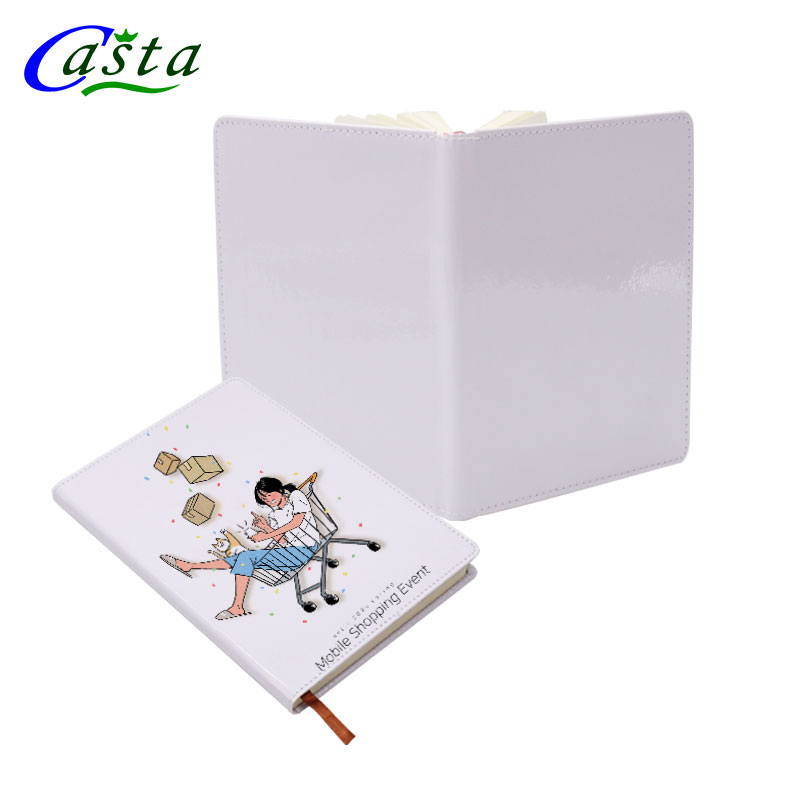
A sublimation leather notebook combines a PU or faux-leather cover with an internal paper block or ring mechanism. The cover surface carries a polyester coating engineered to accept dye-sublimation ink: under heat and pressure, the dye turns to gas and bonds permanently with the coating molecules, so logos, photographs, and full-bleed artwork become part of the material instead of a film printed on top of it. The result resists scratching, peeling, and fading far better than screen printing or glued decals. Because the printable area is the entire cover, one blank serves thousands of designs — a corporate logo for one client, a photographic landscape cover for another, a motivational typography journal for a third — with no plate changes or setup differences. That flexibility is why sublimation leather notebooks have become a staple for print shops building recurring B2B revenue.
First, ordering by lowest unit price. Cheap notebook blanks often use thin coatings that ghost after one wash cycle of heat, or covers that warp at 200°C. Second, skipping pre-production samples: a design that looks perfect on screen can lose dark tones or shift colors on a warm-toned PU base, and only a physical press test reveals it. Third, ignoring edge finishing — raw cut edges on a notebook cover fray after weeks in a bag, which is why stitched or heat-sealed edges matter for perceived quality. Fourth, mismatching press settings to the blank: notebooks with an inserted paper block need pressure compensation so the spine area receives even contact, or you get uneven pressure marks along the spine that customers will notice immediately. Each of these mistakes is avoidable with a supplier who discloses coating specs and press parameters up front.
Retail stationery brands should prioritize A6 and A5 formats with sewn binding — compact journals sell year-round and photograph well for online listings. Corporate gift programs usually order A5 loose-leaf or sewn notebooks with a custom logo debossed area reserved on the back cover, plus matching pen loops; MOQ flexibility matters more than exotic sizes here. Promotional distributors buying for events and onboarding kits should choose mid-weight PU covers that survive shipping cartons, and consider pairing each notebook with a sticky note set to justify a higher invoice value. Wholesalers reselling to other print shops need blanks with consistent coating across batches — variation between batches is the single biggest complaint in this category. For every scenario, ask the supplier for the coating weight, base thickness, and a sample from the exact production batch, not a showroom piece.
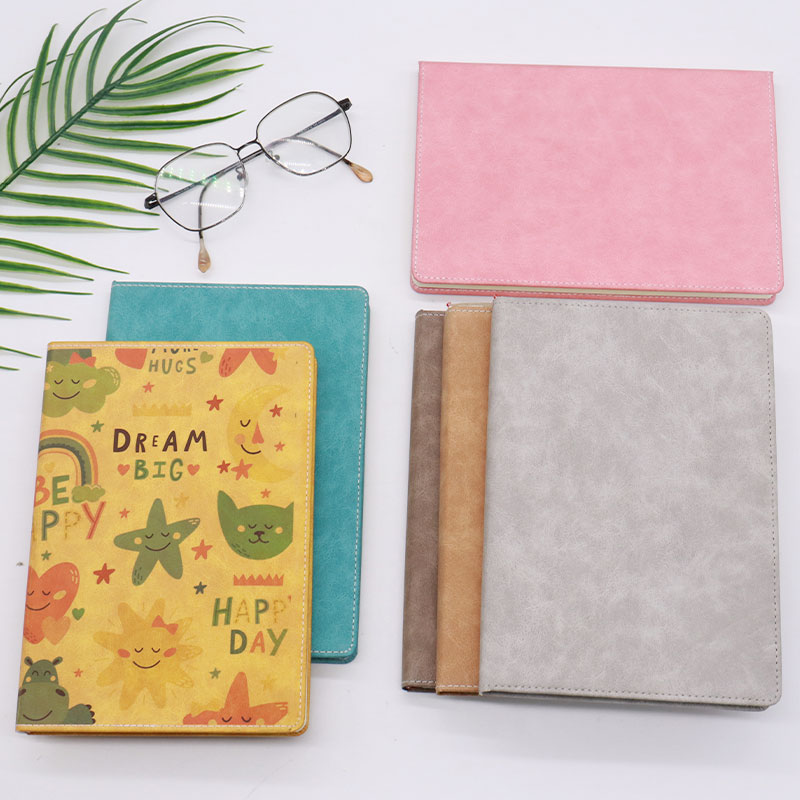
| Spec | A6 Journal | A5 Notebook | A4 Portfolio |
|---|---|---|---|
| Cover size | 105 x 148 mm + wrap | 148 x 210 mm + wrap | 210 x 297 mm + wrap |
| Typical binding | Sewn | Sewn or loose-leaf | Loose-leaf / binder |
| Best use | Retail, gifts | Corporate gifting | Executive kits |
| Press time | 50–60 s | 60–70 s | 70–90 s |
| Print area | Full cover | Full cover + spine | Full cover + flaps |
Use the table to match your press platen: an A4 cover needs a larger platen and longer dwell time, while A6 journals press fast and stack efficiently for bulk runs. If your press is limited to smaller platens, A5 is the practical ceiling for full-bleed work.
Three changes are reshaping the category. First, water-based PU coatings are replacing solvent-based systems, cutting odor and volatile emissions — a selling point for school and office buyers with sustainability targets. Second, recycled-content faux leather has reached print-shop quality: the coating now bonds reliably to recycled bases, letting brands market "eco sublimation notebooks" without sacrificing print vividness. Third, personalization at the unit level has gone mainstream — instead of one logo for an entire order, buyers now request per-cover names or monograms, which sublimation handles trivially because there is no plate per design. Suppliers who pre-cut and pre-stitch blanks with consistent coating, then leave printing to the buyer, are winning share because they make small-batch personalization profitable.
A Singapore stationery brand ordered 3,000 A5 sewn-bound journals for a back-to-school campaign and saw ghosting on the spine from a previous supplier. Our team at Shenzhen Casta Leather Co., Ltd ran two proof rounds: first on coating weight (we raised it from 80 to 110 g/m² on the spine wrap), then on press guidance (we issued a spine-compensation template). The production run printed clean across all 3,000 units and the campaign sold out in five weeks; the client reordered 5,000 for the following semester. A German corporate-gift agency needed 800 A5 loose-leaf notebooks with a two-tone logo and matching pen loop for an automotive dealership event. We die-cut the pen loop from the same PU batch to guarantee color match, pre-tested three press settings at 180°C, 190°C, and 200°C, and shipped with the verified parameter sheet. The agency reported zero defective units and won the dealership's annual gifting contract on the strength of that delivery.
Notebook blanks are a precision category, and our advantages are specific to it. We coat PU leather in-house, so coating weight and uniformity are controlled at the source rather than left to a third party. Our die-cutting keeps cover wrap margins consistent across batches, which matters when a client reorders months later and expects the same printable area. Sewn binding is done on calibrated machines with thread tension checked per shift, preventing the loose-spine defect common in cheap imports. We support low-MOQ OEM/ODM orders — useful for agencies testing a design before committing to volume — and every batch ships with a pre-press sample photo and recommended temperature, time, and pressure settings for the exact blank, not generic values.
The process runs in five steps. One: send your size, binding type, and artwork area — we confirm tooling and coating spec the same week. Two: we produce a pre-production sample with your actual design and courier it for your press test. Three: on approval, we schedule production, coating and die-cutting in-house, stitching either in-house or with audited partners depending on binding type. Four: quality control samples every batch for coating uniformity, edge finish, and dimension; defects are pulled before packing. Five: goods ship with the parameter sheet and packaging matched to your freight mode — carton strength matters for A4 portfolios stacked in containers. Throughout, our team answers press questions directly, because we print on our own blanks daily and know where ghosting and pressure marks come from.
Coating consistency. In-house coating means every cover in a 5,000-unit order prints to the same vividness — the complaint we hear least is also the one that matters most. Format breadth. A6 journals to A4 portfolios, sewn or loose-leaf, with pen loops, bookmarkers, and elastic closures tooled from the same PU family, so a full branded stationery set ships color-matched. Sampling discipline. Two proof rounds before production is our default, not an upsell; it costs days and saves entire shipments. Buyers who visit cncasta.com will find the notebook range listed with coating specs disclosed — a transparency standard we apply across the catalog.
Start at 190°C for 60 seconds at medium pressure, then adjust after a test press. Thicker A4 covers need 70–90 seconds; always verify on a sample from your production batch, since coating weight shifts the optimal dwell time.
Standard A5/A6 formats start at low MOQ for stock colors; fully custom sizes and branded closures are quoted per tooling. We regularly produce trial runs of a few hundred units for agencies validating a design.
Yes. Mixed-SKU consolidation is routine for us — notebooks, matching pen loops, and bookmarkers can share one carton plan, which lowers your freight cost per unit versus ordering each item separately.
Use a silicone pad to equalize pressure across the wrap, and follow the spine-compensation template we provide with sewn-bound blanks. Press pressure should be firm but not maximal — excess force imprints the platen texture into the coating.
Shenzhen Casta Leather Co., Ltd
Hotline : +86 18675583959 (WhatsApp available)
E-mail : yinjinfeng@szcasta.com
Room 101, Unit 1, No.36 Ainan Road, Longdong Community, Baolong Subdistrict, Longgang District, Shenzhen City
Website: https://www.cncasta.com/


