

A sublimation card holder looks like a simple accessory and behaves like a silent salesperson: it sits on a desk during every meeting, gets pulled out at every checkout, and carries a brand into rooms a catalogue never reaches. But card holders are the most dimensionally demanding product in the leather-blank range — narrow slots, tight tolerances, and RFID liners that must sit invisibly under a printed face. This guide explains slot engineering, liner placement, magnetic phone-wallet construction, and gift-set strategy, plus how Shenzhen Casta Leather Co., Ltd builds and customizes card holders for corporate gift programs and retail brands.
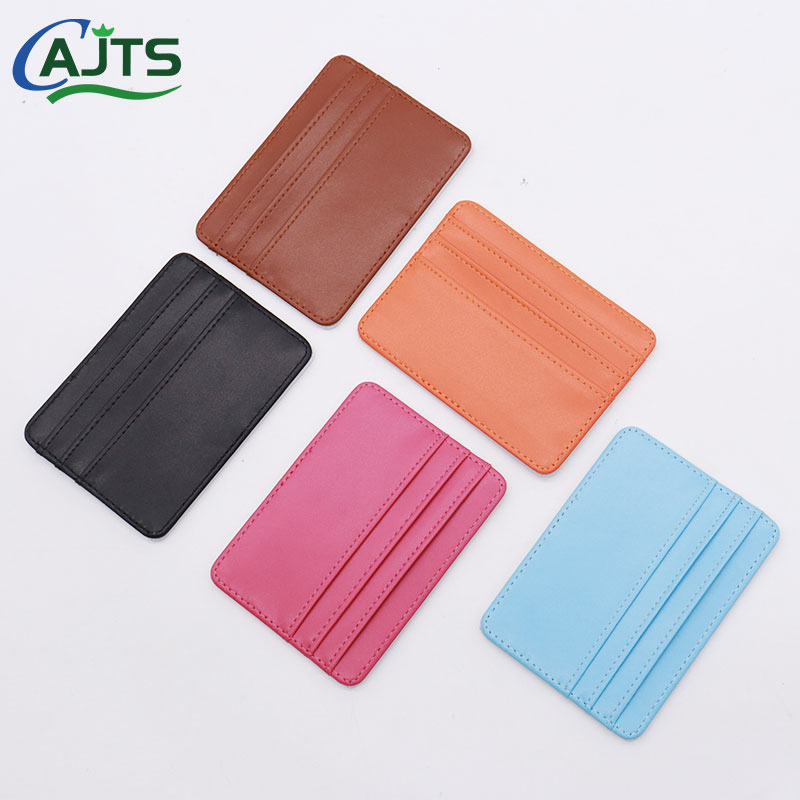
A sublimation card holder is a slim leather accessory designed to carry business cards, credit cards, or transit passes, built from coated PU leather so the outer face can be printed edge to edge. The category splits into three constructions. The sleeve is a single pocket, usually open on two sides, that holds two to four cards. The folder is a bi-fold with two to four stitched slots and often an ID window. The magnetic phone wallet is a flat panel that adheres to the back of a phone, either with a reusable adhesive pad or a magnetic ring, and holds two to three cards.
Construction begins with the panel. PU leather at 0.8 to 1.2 mm is laminated to a thin stiffener so the holder keeps its shape in a pocket without becoming bulky; 1.0 mm is the usual compromise between structure and slimness. The receiving coating is applied to the outer face, and on double-sided designs to the inner faces as well. Because printing happens on the flat panel before folding, the artwork must be laid out around the stitch lines — a detail that decides whether the finished holder looks engineered or improvised.
Slot engineering is the technical heart of the product. A card slot is built from a folded edge of PU, stitched along the base and one side, with an opening height that must clear a laminated card by roughly 1.5 to 2 mm. Too tight and the card binds and delaminates at the corner; too loose and the cards slide out when the holder is held upside down. On multi-slot designs, each slot is offset by 6 to 8 mm so the card edges stagger and remain visible — which is why multi-slot holders feel organized rather than stuffed.
RFID functionality comes from a liner: a thin aluminum or copper mesh, or a metallized film, laminated between the outer PU face and the inner lining. The liner must cover the full card footprint with an overlap at the seams, or a reader can still couple through the edge. It also has to be invisible: a thick or wrinkled liner telegraphs through the printed face as a shadow, ruining a large flat color field. The best construction places a thin, smooth liner under a denser white base coat, so print contrast stays high while attenuation holds.
Mistake 1: Printing across a stitch line. On a card holder, stitching runs 3 to 4 mm inside the edge, and artwork that crosses it gets pierced, puckered, and misaligned. Build artwork inside the stitch line with a 2 mm safe margin, or design a border that the stitch intentionally follows. Ask your supplier for a template showing the stitch path, not just the outer die line.
Mistake 2: Choosing an RFID liner that kills print contrast. A heavy metallized liner under a thin coating makes whites read gray and colors muddy because the metallic layer reflects light back through the ink. Specify a liner under a denser white base, and ask for a pressed sample — not a bare blank — before approving artwork.
Mistake 3: Specifying slots that are too tight for laminated cards. Cards are not 0.76 mm in the real world: lamination, embossing, and a stacked loyalty card add up to 1.2 mm or more. A slot built to the nominal card thickness will bind. Ask for a test with three laminated cards inserted and removed 50 times; if the PU delaminates at the slot mouth, the edge is not sealed properly.
Mistake 4: Selling the holder alone when it belongs in a set. Card holders convert best when paired — a notebook plus a card holder, or a card holder plus a keychain — because the set justifies a gift box and a higher price while keeping freight efficient. Buyers who list a single holder compete on price; buyers who list sets compete on presentation.
Corporate gift and HR buyers should choose a multi-slot folder with a printed outer face and a debossed or printed logo inside. These are handed to new hires, clients, and conference speakers, so the holder must look expensive in the hand while staying under budget: 1.0 mm PU, painted edges, and three slots covers it. Pairing with a notebook from the same material family turns two items into a branded onboarding kit.
Trade show and event marketers need volume and speed. Single-slot sleeves in a standard 95 by 65 mm format print fast, ship flat, and cost little enough to hand out by the thousand. Print the booth number and a QR code on one face, and specify a slightly looser slot so visitors can stuff in a stack of cards without fighting it.
Retail and e-commerce sellers should look at magnetic phone wallets and minimalist wallets. The phone wallet attaches to the back of a handset and is used dozens of times a day — high perceived value, small shipping footprint. Minimalist wallets with an elastic strap or a pull-tab suit buyers moving away from bulky bifolds and photograph well in flat-lay listings.
Travel, hospitality, and loyalty programs use RFID sleeves as a security benefit: a printed sleeve that blocks skimming is easier to justify than a plain one, and hotels and banks can print a room key or card design on the face. Here the liner is the product, so attenuation data matters more than decoration.
| Spec | Single-slot sleeve | Multi-slot folder | Magnetic phone wallet |
|---|---|---|---|
| PU thickness | 0.8 mm | 1.0–1.2 mm | 0.8–1.0 mm plus stiffener |
| Capacity | 2–4 cards | 4–8 cards plus ID window | 2–3 cards |
| Slot clearance | 1.5 mm over card stack | 2 mm, staggered 6–8 mm | 1.5 mm, top-loading |
| RFID liner | Optional | Standard on corporate specs | Optional, thin film preferred |
| Edge finish | Cut, painted, or stitched | Stitched with painted edge | Stitched, low-profile |
| Attachment | None | None | Adhesive pad or magnetic ring |
| Typical MOQ | From a few hundred | From a few hundred | From 500 with tooling |
RFID blocking as a default, not an upgrade. Buyers who used to treat skimming protection as a premium add-on now specify it on standard corporate orders, especially in finance, healthcare, and government tenders. The practical consequence is that liner placement and print contrast have become design constraints rather than afterthoughts.
Phone-wallet formats with magnetic mounting. Magnetic rings and compatible mounting systems have made the back-of-phone wallet a mainstream accessory rather than a sticker. The construction challenge is thickness: the panel must stay under about 4 mm including cards so wireless charging still works on compatible setups, which pushes buyers toward thinner PU and recessed magnet pockets.
Gift-set merchandising. The strongest listings pair a card holder with a notebook, a keychain, or a luggage tag in one material and one print style. Sets photograph as a collection, justify a box, and let a brand tell a single story across desk, pocket, and travel — which is exactly what corporate buyers are trying to buy.
Case 1: A financial services firm ordering 6,000 RFID card holders for a client gifting program. Their previous order from a trading company arrived with print that read gray instead of white and liners visible as a shadow line across the front panel. We re-laminated the liner beneath a denser white base coat, adjusted die-cutting so the liner stopped 1 mm inside the stitch path, and pressed test panels at 195°C for 55 seconds to confirm color fidelity through the liner. Attenuation was verified per batch against a card reader at 13.56 MHz, and 40 units per batch were checked for shadow lines under raking light. The rerun shipped in 21 days with no contrast complaints, and the firm moved its notebook order to the same supplier.
Case 2: A US e-commerce brand fixing slot binding on a minimalist wallet. The brand's wallet used a 1.0 mm slot clearance and customers reported cards sticking and PU delaminating at the slot mouth after a few weeks. We measured the real card stack — three laminated cards at 1.15 mm each — widened the slot to a 2 mm clearance over the stack, and sealed the slot edge with a painted fold rather than a raw cut. Fifty units per batch were cycled with three cards inserted and removed 100 times on a jig. Return rate on the SKU fell from 8.4% to 2.1% in the following quarter, and the brand applied the same slot spec to its passport cover line.
Shenzhen Casta Leather Co., Ltd produces card holders as a precision leather good, which is what this category demands: narrow slots, tight stitch paths, and a liner that must disappear under print. For this product specifically, our relevant capabilities are matched die-cutting and creasing that keep slot openings within tolerance, in-house stitching with sealed slot edges so cards do not catch, liner lamination under a density-checked white base for both attenuation and print contrast, and per-batch RFID verification against a 13.56 MHz reader. We also build the notebooks, keychains, and luggage tags that pair with holders, so gift sets come from one line with one material spec. Holder formats and set options are shown at https://www.cncasta.com/.
Our process is organized around the two features that decide quality: slot geometry and liner placement. First, material and liner selection: PU is qualified at 0.8 to 1.2 mm, and the liner is chosen by thickness and smoothness so it will not telegraph through the face. Second, lamination and coating: liner and PU are bonded under controlled pressure, then the white base and receiving layer are roll-applied and density-checked per batch. Third, die-cutting and creasing: outer panels, slot openings, and fold lines are cut in matched operations, with slot clearance set 1.5 to 2 mm over the target card stack. Fourth, printing support: we issue templates showing the die line, the stitch path, and the safe zone, so artwork never crosses a needle line. Fifth, assembly: slots are folded and stitched with sealed mouths, ID windows are welded, and magnetic phone wallets get recessed magnet pockets or adhesive pads applied at a fixed depth. Sixth, validation: sampled units are pressed at 200°C for 60 seconds, then checked for slot binding with a laminated card stack, RFID attenuation, stitch alignment, and shadow lines on the printed face before packing flat with interleaves.
It can, if the liner is thick or wrinkled or sits directly under a thin coating — the result is gray whites and a faint shadow across the panel. We laminate a smooth, thin liner beneath a denser white base and press test panels before production, so contrast stays high while attenuation holds at 13.56 MHz.
Plan for 1.5 to 2 mm over the real stack, not the nominal card thickness. Three laminated cards measure about 3.5 mm in practice; a slot built to 3 mm will bind. On multi-slot designs, stagger the slots by 6 to 8 mm so card edges stay visible and the holder feels organized.
On compatible magnetic mounting systems, yes, provided the total thickness including cards stays around 4 mm. That is why phone-wallet panels use 0.8 to 1.0 mm PU with recessed magnet pockets instead of thick board. Test with the actual phone model before committing to a large order.
Standard sleeve and folder formats start in the low hundreds of pieces per design; magnetic phone wallets typically start at 500 with tooling. Prototypes are ready in about a week, and bulk production runs two to four weeks depending on stitching and liner requirements. Send artwork to yinjinfeng@szcasta.com or call +86 18675583959 (WhatsApp available) for a quote.
Shenzhen Casta Leather Co., Ltd
Hotline : +86 18675583959 (WhatsApp available)
E-mail : yinjinfeng@szcasta.com
Room 101, Unit 1, No.36 Ainan Road, Longdong Community, Baolong Subdistrict, Longgang District, Shenzhen City
Website: https://www.cncasta.com/


