

If you buy sublimation blanks to print and resell, the blank itself decides whether your finished product looks premium or cheap. A well-coated PU leather blank takes full-color transfers with sharp edges and no yellowing; a poorly coated one ghosts, peels, and generates returns. This guide explains what separates a professional-grade leather sublimation blank from a bargain-bin one, which mistakes cost buyers the most money, and how we at Shenzhen Casta Leather Co., Ltd engineer, test, and ship blanks for gift brands, print shops, and corporate buyers worldwide.
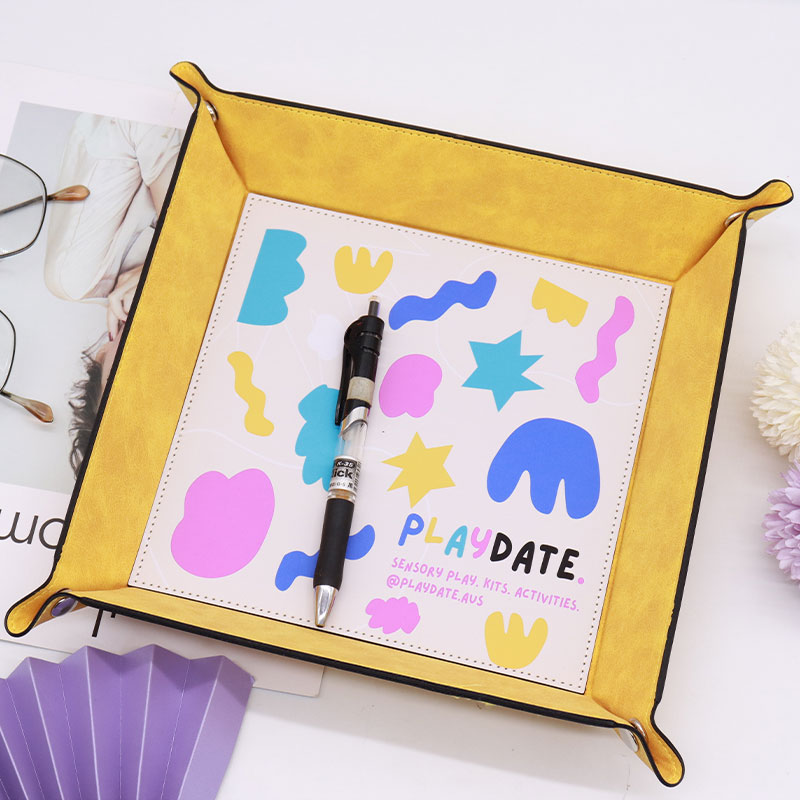
A sublimation blank is an unfinished product — a notebook cover, valet tray, keychain, luggage tag, or card holder — manufactured with a printable surface that accepts dye-sublimation ink. Under heat and pressure, solid sublimation dye converts directly into gas and bonds with polyester molecules, so the artwork becomes part of the surface rather than a layer sitting on top of it. That is why sublimated leather goods survive daily handling, flexing, and moisture far better than screen-printed or glued decorations.
Because sublimation dye only bonds with polyester, a "sublimation leather" blank is a polyurethane or faux-leather shell engineered with a high-polyester receiving layer. The quality variable is not the leather look — it is the coating. If the receiving layer varies by even a few microns across the panel, you get uneven color density, faded patches, or a yellow cast after pressing. A professional supplier coats in continuous rolls under controlled viscosity, then die-cuts panels so every unit behaves identically on the press. Cheaper suppliers coat in batches and cut from offcuts, which is why their blanks print differently from carton to carton.
Edge treatment is the second hidden variable. Sublimation ink wraps only the surface the coating covers; raw cut edges stay white and look unfinished. Quality blanks seal edges with edge paint, folding, or stitching so the finished piece reads as a real leather product, not a printed sticker on foam.
Mistake 1: Judging blanks by unit price alone. A blank that costs 20% less but ghosts on 15% of units and triggers returns is dramatically more expensive. Ask for coating thickness specs and batch consistency data before comparing prices — a factory that cannot produce those numbers is telling you something.
Mistake 2: Skipping pre-production samples. Buyers often approve from a photo and discover at production volume that the white surface yellows at 195°C, or that the panel size does not fit standard presses. Always run one physical sample through your own press and your own artwork before committing to a container.
Mistake 3: Ignoring edge sealing and hardware. On keychains and luggage tags, the metal ring and clasp are stress points. Zinc alloy hardware stamped from soft alloy bends within weeks; quality blanks use cast rings tested for pull strength. On trays, unsealed corners split after two folds. Inspect these details on the sample, not after delivery.
Mistake 4: Not matching the blank to your press workflow. A thin flat blank presses beautifully in a clamshell press; a thick folded tray needs even pressure across a raised form and often a two-stage press. If your workshop runs one clamshell at fixed settings, choose blank formats that fit that workflow, and confirm the supplier's recommended time/temperature window in writing.
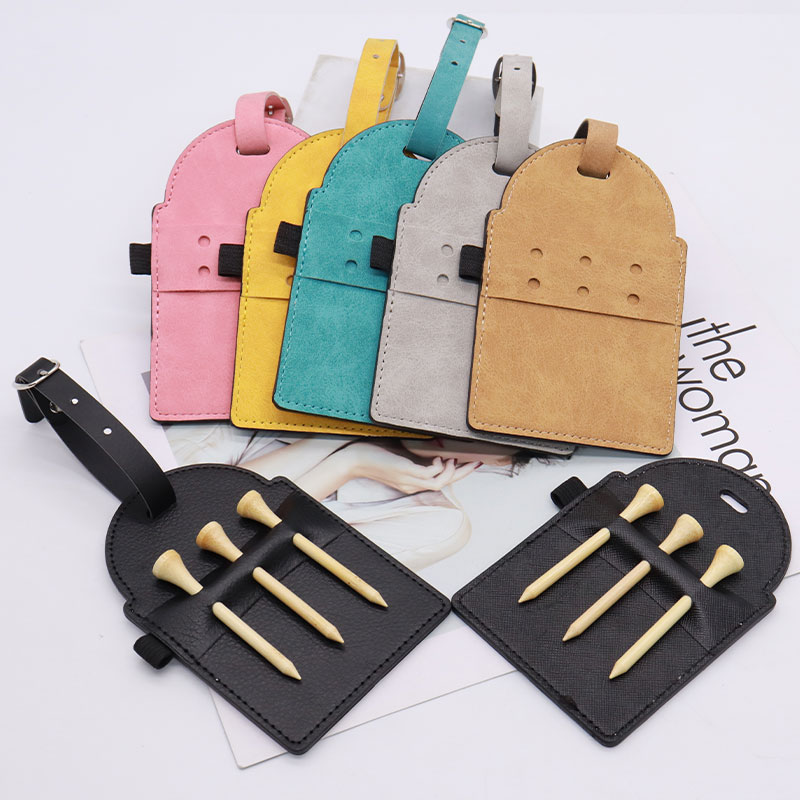
Retail and e-commerce sellers should start with fast-turning personalization items: sublimation leather keychains, luggage tags, and card holders. These are small, ship flat, cost little to hold in inventory, and photograph well for listings. Round, rectangle, and heart-shaped keychain blanks with double-sided printable surfaces let one design ship in multiple variants.
Stationery and journal brands should focus on A4/A5/A6 sublimation leather notebooks — sewn-binding journals for the premium tier and loose-leaf binder covers for the DIY tier. The cover is the printable canvas; pair it with pen loops and bookmarkers for bundle offers that raise average order value.
Corporate and promotional buyers get the most mileage from passport covers and travel wallet sets, often bundled with luggage tags as Mr & Mrs or company-branded travel kits. A logo printed edge-to-edge on a PU passport cover survives passport pockets far better than a foil stamp.
Hotels, restaurants, and lifestyle brands use foldable sublimation valet trays and storage trays as welcome amenities and desk organizers. Because trays ship flat and fold on site, freight cost per unit is low, and the inner bottom panel is a generous printing canvas.
Water-based and lower-odor coatings. Buyers in the EU increasingly ask about REACH and odor tests; coating chemistry has shifted accordingly. If you sell into Europe, request the test reports before your first order.
Hybrid formats. The line between categories keeps blurring — passport covers with RFID-blocking layers, keychains doubling as AirTag-style tracker holders, and notebook covers with integrated phone stands. These hybrids command higher margins than plain blanks because they solve two problems at once.
Small-batch personalization economics. Digital sublimation removed the plate cost, so the winning move for retail brands is now many designs at low quantity rather than one design at high quantity. Suppliers that support low MOQs per artwork — as Casta Leather does for custom logo orders — have become the default partner for this model.
Case 1: A US gift retailer killing ghosting returns. The client bought unbranded notebook blanks from a trading company and saw a 12% return rate driven by faded, patchy prints. We diagnosed the issue in one round: their supplier was coating in small batches with no density QC. We supplied production samples from three consecutive coating batches, ran density test prints with the client's artwork, and documented color difference values per batch. Switching to our roll-coated A5 sewn journals with stitching-sealed edges cut their return rate below 1.5% within two months, and the consistent white substrate let them standardize one press recipe across all journal sizes.
Case 2: A German automotive dealership needing branded travel kits. The buyer wanted 800 travel kits — passport cover plus luggage tag — with dealer branding, delivered before a sales campaign. We prototyped the logo layout on both items in five working days, adjusted artwork placement to avoid the stitching channel on the passport cover, and ran a first-article press test at 185°C/50s to lock color. Production, edge painting, and hardware assembly finished in 18 days, and the kits shipped with per-kit poly bags and insert cards. The dealership reordered at double volume the following quarter.
Shenzhen Casta Leather Co., Ltd is a specialized manufacturer of sublimation-ready PU leather products — not a trader reselling someone else's output. For sublimation blanks specifically, our relevant capabilities are coating control, die-cutting accuracy, and finishing craftsmanship: roll-coated receiving layers with per-batch density checks, in-house die-cutting that holds panel dimensions within tight tolerance for repeatable print templates, and edge painting or stitching that makes blanks finish like genuine leather goods. Our catalog covers the full blank range — notebooks, passport covers, luggage tags, trays, keychains, and card holders — so buyers can consolidate several SKU families with one supplier and one QA standard. You can browse the current range at https://www.cncasta.com/.
Our production method follows the same sequence on every blank family. First, material selection: we qualify PU and faux-leather rolls for surface smoothness and heat stability before they enter the coating line. Second, roll coating: the sublimation receiving layer is applied continuously and checked for uniformity, so panel one and panel one thousand press identically. Third, die-cutting and forming: panels are cut to exact print templates, and 3D formats like trays are creased so they fold cleanly without cracking the coating. Fourth, finishing: edges are painted, folded, or stitched, and hardware — rings, clasps, snaps — is assembled and pull-tested. Fifth, pre-shipment press testing: we run sample prints from the actual production batch at 200°C/60s and inspect for ghosting, yellowing, and adhesion before packing. Finally, packaging: blanks ship flat with interleaves that prevent surface abrasion in transit.
Start at 185°C, 50 seconds, light-to-medium pressure, with the print face up and a protective sheet. Validate on a sample from your batch; dense full-bleed designs may need 5–10 more seconds. Casta Leather validates every blank family at 200°C/60s, so you have headroom.
Standard blank styles usually ship from stock with no artwork commitment. Custom logo orders typically start from a few hundred pieces per design depending on the product; contact us with your artwork for an exact quote.
Both. Many buyers press in-house for flexibility; we also offer factory printing for bulk corporate orders so you receive finished, ready-to-sell goods. Factory printing uses the same blanks and our calibrated presses, with color proofing before mass production.
Coating runs are density-checked per batch, panels are die-cut from the same coating run per order, and we run pre-shipment press tests on actual production samples. If any parameter drifts, the order is re-validated before it leaves the factory.
Shenzhen Casta Leather Co., Ltd
Hotline : +86 18675583959 (WhatsApp available)
E-mail : yinjinfeng@szcasta.com
Room 101, Unit 1, No.36 Ainan Road, Longdong Community, Baolong Subdistrict, Longgang District, Shenzhen City
Website: https://www.cncasta.com/


