

Keyless entry is convenient until a thief walks past your driveway with a signal amplifier and drives away with your car. A well-built Faraday box stops that attack in seconds by blocking the key fob's radio signal entirely. This guide explains how signal blocking actually works, which materials and linings matter, how to test a box with your own fob before trusting it, and how Shenzhen Casta Leather Co., Ltd manufactures, inspects, and customizes Faraday boxes for retailers, car dealerships, and insurance-branded giveaways worldwide.
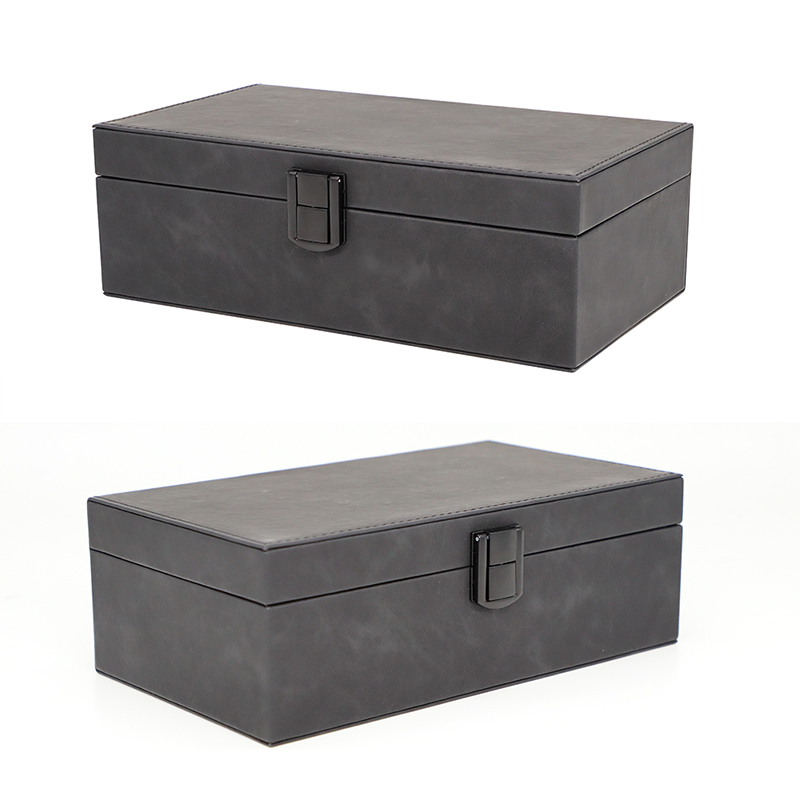
A Faraday box is a rigid storage container engineered to behave like a Faraday cage: an enclosure of conductive material that redistributes electromagnetic energy across its surface so the interior stays shielded. Modern car key fobs constantly emit low-power signals at 315 MHz or 433 MHz; relay attack devices capture that signal, amplify it, and rebroadcast it to the car, tricking the vehicle into thinking the key is beside the door. When the fob sits inside a properly built Faraday box, the conductive layers absorb and redirect those emissions, and the relay device receives nothing to amplify.
The performance of a Faraday box lives or dies on two details: the shielding layers and the closure. A quality box combines an outer shell — PU leather, velvet-wrapped board, or carbon-fiber-textured material — with an inner conductive lining, often a laminated metal-fiber fabric, that covers the floor, walls, and lid without gaps. Shielding effectiveness is measured in decibels; professional-grade boxes target 60 dB or higher across the relevant bands, which reduces a 433 MHz fob signal to an undetectable whisper. The closure matters just as much: if the lid gap is wide or the lining does not overlap when closed, signal leaks through the seam and the box becomes decoration.
Interior finish also separates premium boxes from cheap ones. Because key fobs, watches, and cards sit directly on the lining, manufacturers add a soft velvet or microfiber layer over the shielding fabric to prevent scratches. A box that looks good but scratches a customer's fob screen generates complaints; a box with a plush lining and clean stitched edges reads as a genuine leather accessory worth displaying on the entryway table.
Mistake 1: Trusting boxes that were never tested. The market is full of decorative boxes with a thin shielding sticker inside. Test every supplier's sample with your own fob: place the fob inside, close the lid, and have someone stand next to the car and press the door handle. If the car unlocks, the box fails. Serious suppliers test with live fobs per batch and can share test method descriptions — not just marketing claims.
Mistake 2: Judging lining quality by feel alone. A thick lining that feels luxurious may have poor conductive continuity, while a well-laminated metal-fiber layer may feel unremarkable. Conductivity is a functional property, not a tactile one. Ask how the lining is bonded to the shell, whether seams are overlapped, and whether the lid lining makes continuous contact when closed.
Mistake 3: Buying the wrong size for the household. A compact box holds one or two fobs; a family with three cars plus garage remotes and smartwatch keys needs a wider tray-style box or a two-tier design. Retailers who stock only one size lose the second sale; buyers who guess sizes end up returning them.
Mistake 4: Ignoring placement and daily habits. A Faraday box only works when the fob is actually inside it and the lid is fully closed. Boxes placed in a hallway console or bedside table encourage the habit; boxes hidden in drawers do not. Also remember that a fob clipped to a second keyring that hangs outside the box is unprotected — the whole fob must go in.
Retail and e-commerce sellers should prioritize compact boxes with strong unboxing appeal: velvet or PU leather exteriors, magnetic or snap closures, and a removable internal divider so one SKU serves both single-fob and multi-fob buyers. Product photography matters — a box that photographs like a valet case sells at gift-level margins.
Corporate gift and dealership buyers should look for boxes with a large flat branding area on the lid. Debossed or foil-stamped logos on PU leather survive handling far better than printed logos on fabric. Car dealerships increasingly include a branded Faraday box in every new-car handover kit, which keeps their logo in the customer's hallway for years.
Insurance companies and fleet operators often buy in bulk as part of anti-theft education campaigns. For these buyers, consistency matters most: every unit must test identically, packaging must carry clear usage instructions, and the supplier must support repeated reorder runs with the same specification.
Wholesale and distributor buyers should consolidate sizes: a range covering compact, medium, and large boxes lets one container serve different market segments, and mixed-style orders from one manufacturer avoid trading-company markups while keeping QA standards uniform.
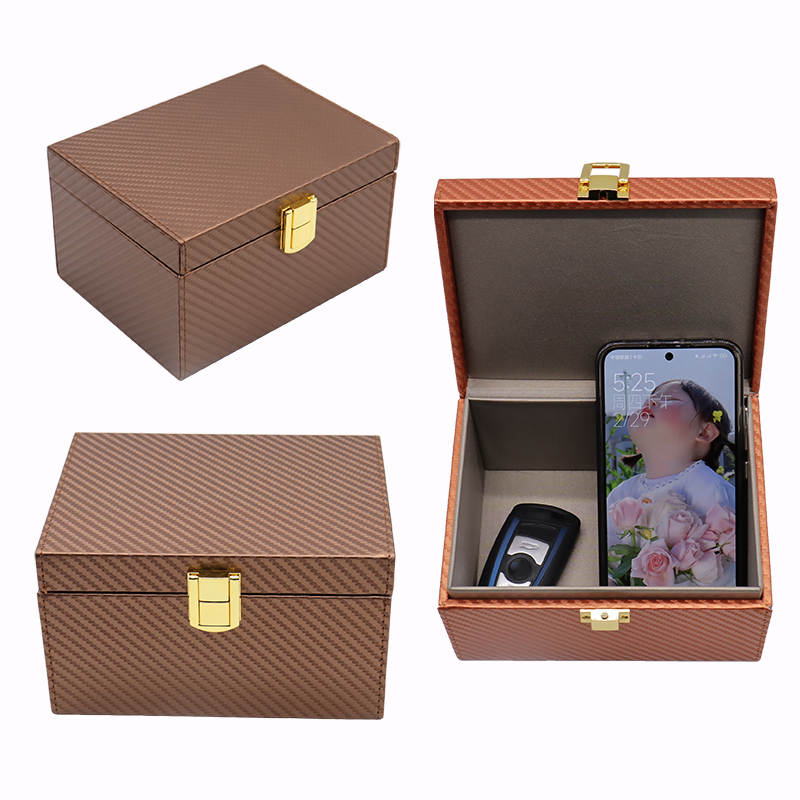
Leather-wrapped interiors meet stricter material expectations. EU and US buyers increasingly request low-odor materials and REACH-compliant adhesives for anything stored in bedrooms and hallways. Lining lamination has shifted toward water-based bonding, and suppliers who hold current test reports win the paperwork-heavy tenders.
Hybrid storage formats. New designs combine Faraday shielding with everyday organization: boxes with a shielded lower compartment for fobs and an open upper tray for coins and glasses, or dual-chamber boxes where one chamber is shielded and one is not for non-sensitive items. These hybrids raise perceived value without raising freight weight much.
Corporate branding on security products. As relay-theft stories spread in national media, insurance firms and car brands treat Faraday boxes as educational merchandise. That means higher demand for understated premium finishes — matte PU leather, tone-on-tone debossing — rather than flashy tech looks, because the box must sit naturally in a home entryway.
Case 1: A UK insurance company running an anti-theft campaign. The client planned to ship 5,000 branded Faraday boxes to policyholders in high-theft postal districts. Their previous supplier's units failed on-site testing at two regional offices — fobs inside the closed boxes still unlocked cars. We reproduced the failure, found the lid lining stopped short of the seam overlap, and re-engineered the lid with a full-contact folded lining plus a magnetic closure aligned to pull the lid flush. We then ran a live fob test on 100 units per production batch — placed inside, door-handle press, no unlock — and documented results per batch. The campaign shipped on schedule, the client's complaint rate stayed below 0.3%, and they reordered for a second-year campaign at the same specification.
Case 2: A German car dealership group wanting handover kits. The buyer wanted a premium box that matched their interior brand style: matte PU leather, debossed logo, velvet interior, sized for one fob plus a house key. We provided a prototype in five working days with two logo placement options, adjusted the deboss depth so the logo read cleanly under showroom lighting without wrinkling the leather, and locked the color on a physical approval sample before mass production. Production of 1,200 units finished in 20 days, each box packed in a flat carton with a multilingual instruction card. The dealership reported that customers specifically mentioned the box during service visits, and the group expanded the kit to a second brand the following quarter.
Shenzhen Casta Leather Co., Ltd is a leather goods manufacturer whose Faraday box line benefits directly from our core craft: premium exterior finishing, precise interior assembly, and disciplined batch testing. For Faraday boxes specifically, our relevant capabilities are leather wrapping and stitching quality that make the box presentable in a home, lining lamination with verified seam overlap for continuous shielding, and hardware and magnetic closures calibrated so the lid closes fully every time. We hold exterior material options across velvet, PU leather, and carbon-fiber texture, and we test with live key fobs on production batches rather than relying on laboratory claims alone. Current box models and customization options are listed at https://www.cncasta.com/, and we welcome buyers to test samples with their own fobs before committing.
Our production sequence treats shielding as an engineering step, not an afterthought. First, material qualification: shell boards and conductive lining rolls are inspected for flatness and continuity before entering production. Second, lining lamination: the conductive layer is bonded with overlaps at every seam, and the fold direction is specified per model so the lid lining meets the wall lining with full contact. Third, exterior wrapping: PU leather or velvet is wrapped and glued with controlled adhesive weight, then stitched on edge channels so corners stay tight after months of handling. Fourth, interior finishing: the velvet scratch layer and optional dividers are installed, and magnets are seated so closure force is consistent across units. Fifth, batch testing: sample units from each production batch are tested with live 315/433 MHz fobs — signal blocked with the lid closed, fob working normally on removal. Sixth, packing: boxes ship nested with protective interleaves and instruction cards, ready for retail or direct-to-customer campaigns. Throughout, a pre-shipment inspection samples stitching, lining contact, and closure alignment before cartons are sealed.
Place your key fob inside, close the lid fully, and walk to the car with a second person; press the door handle and try the start button. If nothing responds, the box is blocking correctly. Repeat after a week of daily use — seams can shift on cheap boxes. For bulk orders, we recommend testing ten units from the first carton; our batches are tested with live fobs before shipment.
Yes, a properly shielded box blocks 13.56 MHz RFID card signals and typically reduces cellular signals to no-service levels. However, phones generate heat and emit on many bands, so we recommend boxes primarily for fobs and cards; for phones, a dedicated Faraday bag sized for devices works better.
Yes. Debossed or foil-stamped logos on the lid start from a few hundred pieces per design, and we support custom instruction cards and retail boxes. Send your artwork through yinjinfeng@szcasta.com or call +86 18675583959 (WhatsApp available) for a sample proposal.
Standard models ship from stock in small quantities; custom logo orders typically start from a few hundred pieces with sampling in about one week and bulk production in two to three weeks depending on quantity and finish. Every order is batch-tested before dispatch, and repeat orders run to the approved golden sample.
Shenzhen Casta Leather Co., Ltd
Hotline : +86 18675583959 (WhatsApp available)
E-mail : yinjinfeng@szcasta.com
Room 101, Unit 1, No.36 Ainan Road, Longdong Community, Baolong Subdistrict, Longgang District, Shenzhen City
Website: https://www.cncasta.com/


