

A sublimation leather keychain is the cheapest product in the personalization catalogue and the one buyers reorder most, because a two-dollar blank can sell for eight and carry a brand into someone's pocket for years. It is also the hardest format to print well: a 40 mm blank leaves no room for error, hardware quality decides whether the product feels like a gift or a giveaway, and metal fittings quietly dominate the unit cost. This guide covers blank shapes, PU and zinc alloy hardware combinations, double-sided blanks, carabiner and tracker-holder designs, promotional economics, and how Shenzhen Casta Leather Co., Ltd produces keychains for car dealers, real estate firms, and promotional distributors.
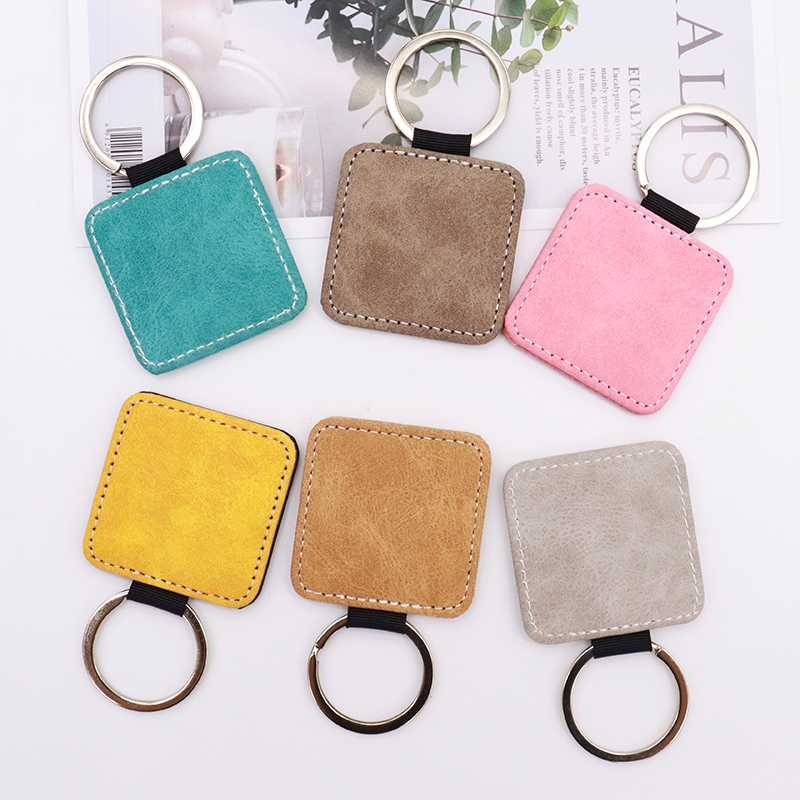
A sublimation leather keychain is a small printed leather blank joined to a key ring, strap, or clip. The blank is the product: a piece of white PU leather with a polyester receiving coating, die-cut to shape, printed flat, then married to hardware. Because printing happens before assembly, the artwork wraps the blank edge to edge with no fixture getting in the way — which is why sublimation produces a richer, more photographic result on a keychain than pad printing or laser engraving on the same material.
Three build layers matter. The face is PU leather, usually 1.4 to 2.0 mm for a keychain so the blank feels solid rather than floppy. Inside sits a stiffener — a thin board or a second PU layer — that keeps the blank from curling in a pocket. The edge is either cut clean, painted, or stitched; on a small blank, edge finishing is what separates a retail product from a promotional trinket, because a raw cut edge shows white core and frays with use.
Hardware is where most of the perceived value lives. The common combinations are a PU loop stitched to a zinc alloy split ring, a riveted leather strap with a swivel snap, or a metal frame plate sandwiched around the blank for a framed look. Zinc alloy is the default because it plates well and holds detail; stainless steel costs more but resists tarnish in humid climates; brass gives a warmer tone that suits heritage branding. Plating quality, not alloy, is what fails first — a thin nickel flash on a cheap ring pits within months, and a keychain that rusts in a customer's pocket damages the brand it was supposed to promote.
Two variations have reshaped the category. The carabiner format replaces the split ring with a spring clip so the keychain can hang from a belt loop or a bag strap — practical, and popular with car dealers who hand keys over at delivery. The tracker-holder format is a leather sleeve sized for a Bluetooth tracker, which turns a giveaway into an accessory people buy deliberately. Double-sided blanks, printable on both faces, cost marginally more and double the usable artwork area, which is why they dominate corporate orders.
Mistake 1: Specifying hardware without asking about plating. Two keychains can look identical in a photo and differ entirely in the metal. Ask for the plating thickness and the salt-spray hours on the ring — a promotional keychain should survive at least 24 hours of salt spray without pitting. Request a hardware sample and leave it in a humid place for two weeks; the result tells you more than any spec sheet.
Mistake 2: Printing without bleed on a small blank. On a 40 mm round blank, a 2 mm registration error is five percent of the diameter and immediately visible as a white crescent at the edge. Build artwork at the exact die line plus 3 mm bleed, keep text and logos at least 2 mm inside the cut, and ask for a physical proof on the actual blank rather than a digital mockup.
Mistake 3: Buying single-sided blanks for a two-sided product. A keychain is handled from both sides — one face is seen hanging, the other when it lies on a counter. Double-sided blanks cost a little more and eliminate the dead white back that makes a printed keychain feel unfinished. For corporate gifts, put the logo on one side and a phone number, QR code, or campaign message on the other.
Mistake 4: Letting unit price decide a giveaway. The gap between a 0.35 USD and a 0.55 USD keychain is invisible on a purchase order and obvious in a hand. Cheap blanks use thin PU that creases, hardware that discolors, and stitching that pulls. For dealer handover gifts and real estate closing gifts, the keychain is often the only physical object the customer keeps — spend the twenty cents.
Car dealers and dealership groups should use a carabiner or riveted strap format with the brand mark on one face and the service department number on the other. These are handed over with the keys, so they are seen at the highest-emotion moment in the purchase; specify a metal that will not tarnish in a hot car and a blank thick enough to survive a glovebox.
Real estate agencies favor a rectangle or house-shaped blank with the agent's name, phone, and a QR code to the listing page. A double-sided blank with a photo of the property on the reverse turns a closing gift into a keepsake, and the format prints well at 30 by 50 mm without crowding.
Promotional distributors and event marketers need the economics to work at 5,000 units and up. Round and square blanks in standard sizes keep tooling costs at zero, stock hardware keeps lead times short, and one-color-plus-logo artwork keeps press time predictable. Ask for units per carton and carton weight early, because keychains are light but bulky.
Retail and travel brands can charge a premium with shaped blanks — hearts, ovals, state and country silhouettes — finished with painted edges and a branded backing card. A keychain on a printed card photographs like a gift, and gift shops, museum stores, and airport retailers buy them in depth.
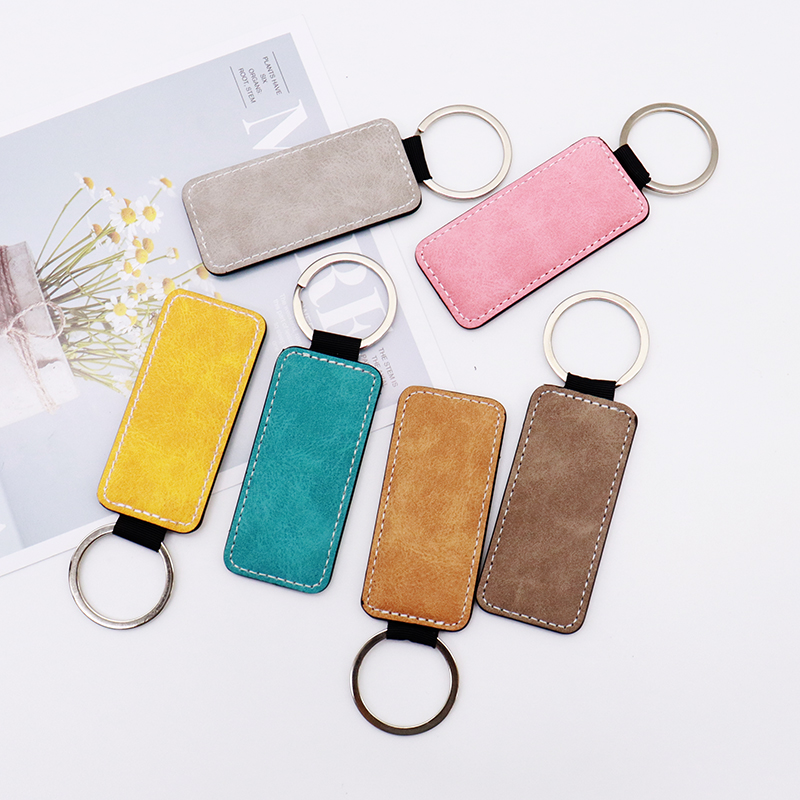
Laserable leatherette as a second finish. Buyers increasingly order the same blank in two versions — sublimation-coated for full color and laserable leatherette for engraved monochrome — so one product line serves both a photo-heavy campaign and a premium etched-gift SKU. Keeping one shape across both finishes simplifies the catalogue and the packaging.
Tracker-holder designs. Bluetooth tracker sleeves have become a genuine accessory category rather than a novelty, and they command three to four times the price of a plain keychain. The manufacturing challenge is dimensional: the sleeve must grip the tracker firmly enough not to drop it and loosely enough to swap the battery.
Recycled PU and plating compliance. EU promotional buyers now request recycled-content PU and confirmation that metal plating is nickel-release compliant under REACH. Suppliers who can produce current test reports are winning tenders that used to be decided purely on price.
Case 1: A German automotive dealership group with a 20,000-piece handover program. The group's previous keychains arrived with visible white crescents at the edge of the round blank and rings that discolored in showroom heat within a season. We rebuilt the artwork with 3 mm bleed and a 2 mm safe zone, switched the blank from 1.4 mm to 1.8 mm PU with a painted edge, and moved the ring to a thicker zinc alloy plating validated at 48 hours of salt spray. Sampling ran at 30 units per batch with a go/no-go gauge on edge coverage, and the first 6,000 units shipped in 18 days. Edge rejects went from roughly one in twelve to zero on the sampled batches, and the group extended the program to its used-car division.
Case 2: A US promotional distributor losing money on a real estate closing gift. The distributor was paying 0.31 USD per keychain and absorbing a 7% credit rate for curled blanks and split stitching at the loop. We diagnosed the curl as a single-layer blank with no stiffener and the stitch failure as a loop attached with a single row of stitches through coated PU. We moved to a two-layer blank with a board stiffener, added a bar-tack at the loop junction, and pull-tested 50 units per batch at 5 kg static load. Unit cost rose to 0.44 USD, credits fell below 1%, and the distributor's margin improved because the client stopped re-shipping replacements.
Shenzhen Casta Leather Co., Ltd makes keychains as a small-format leather good, which is a different discipline from printing flat sheets. For this category specifically, our relevant capabilities are matched die-cutting that holds shape tolerances on 30 to 50 mm blanks, painted or stitched edge finishing that seals the core, in-house hardware assembly with riveted and bar-tacked attachments, and batch pull-testing of every hardware lot. We coat our own PU panels, so the printable face is consistent enough that one press recipe works across a 5,000-piece run and the back face of a double-sided blank matches the front in density. Because the same shapes are available in sublimation and laserable finishes, buyers can run one shape across multiple price tiers. Product photos and shape options are at https://www.cncasta.com/.
Six steps carry a keychain from material to carton. First, blank selection: PU thickness is chosen per use case — 1.4 mm for volume promotions, 1.8 to 2.0 mm for retail — and the stiffener layer is specified at the same time. Second, coating: receiving layers are roll-applied and density-checked per batch, and for double-sided orders both faces come off the same roll so colors match. Third, die-cutting: stock shapes are cut on existing dies with no tooling charge, while custom silhouettes get a dedicated die and a physical proof before production. Fourth, printing support: we issue artwork templates at the exact die line with 3 mm bleed and safe zones, and can press bulk artwork in-house after color approval. Fifth, assembly: hardware is attached with rivets or bar-tacked stitching, loops are pull-tested at 5 kg, and plating lots are checked before they enter the line. Sixth, final inspection: sampled units are checked for edge coverage, print registration on the small blank, hardware discoloration, and stitch integrity, then packed on printed backing cards or in poly bags with an optional display-ready header.
Use 185 to 195°C for 45 to 60 seconds at light-to-medium pressure, with the blank on a firm base so pressure is even across the whole shape. Small blanks heat fast, so avoid pushing temperature to compensate for a cold platen — measure the platen instead. Our blanks are validated at 200°C for 60 seconds without yellowing.
Body text below 7 pt blurs on PU coating, so keep phone numbers and URLs at 8 pt or larger and skip fine print entirely. At 35 mm diameter you can comfortably fit a logo, one line of text, and a QR code of at least 15 mm; below that, drop the text and keep the mark.
For corporate and dealer programs, yes — the reverse face is seen whenever the keychain lies on a counter, and an unprinted white back undercuts the whole product. The cost step is small, typically a few cents per unit, and it lets you put the logo on one side and a contact or campaign message on the other.
Stock shapes with custom printing start in the low hundreds of pieces per design. Custom silhouettes need a die, which adds about a week to the timeline; prototypes are typically ready in seven working days. Send artwork and quantities to yinjinfeng@szcasta.com or call +86 18675583959 (WhatsApp available) for pricing.
Shenzhen Casta Leather Co., Ltd
Hotline : +86 18675583959 (WhatsApp available)
E-mail : yinjinfeng@szcasta.com
Room 101, Unit 1, No.36 Ainan Road, Longdong Community, Baolong Subdistrict, Longgang District, Shenzhen City
Website: https://www.cncasta.com/


