

A sublimation leather tray is the quiet workhorse of the personalization category: cheap to ship, simple to print, and useful enough that buyers keep it on a desk or nightstand every day. Yet trays are also where cheap suppliers get exposed, because a foldable tray that pops out of shape or a base that sags under a watch is an instant return. This guide breaks down foldable valet trays, corner hardware, base construction, inner-panel printing, and the real cost math behind hotel amenity and corporate welcome-gift programs, plus how Shenzhen Casta Leather Co., Ltd builds, tests, and customizes trays for buyers in the US and EU.
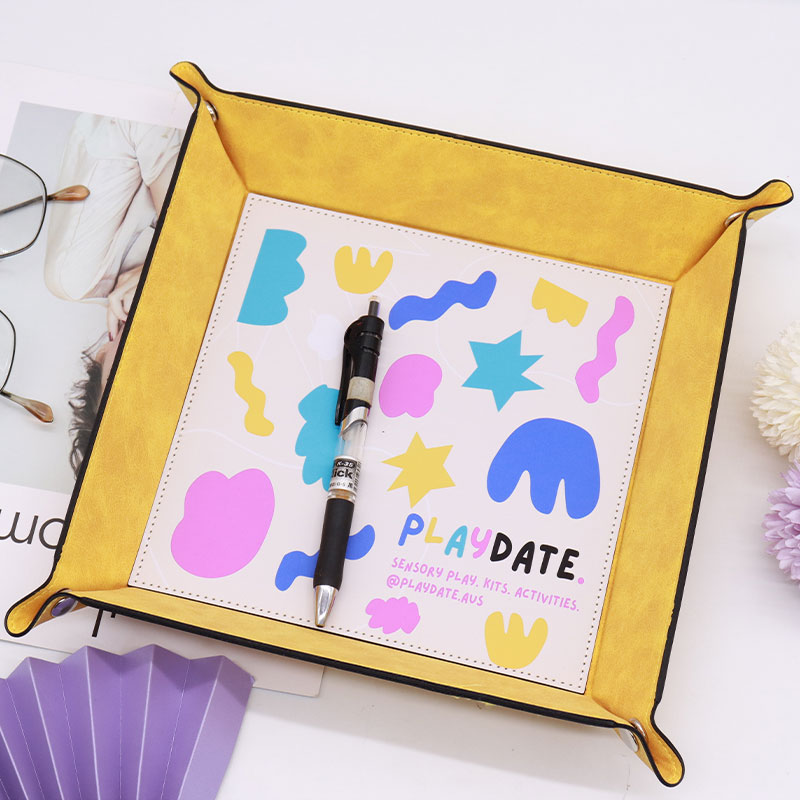
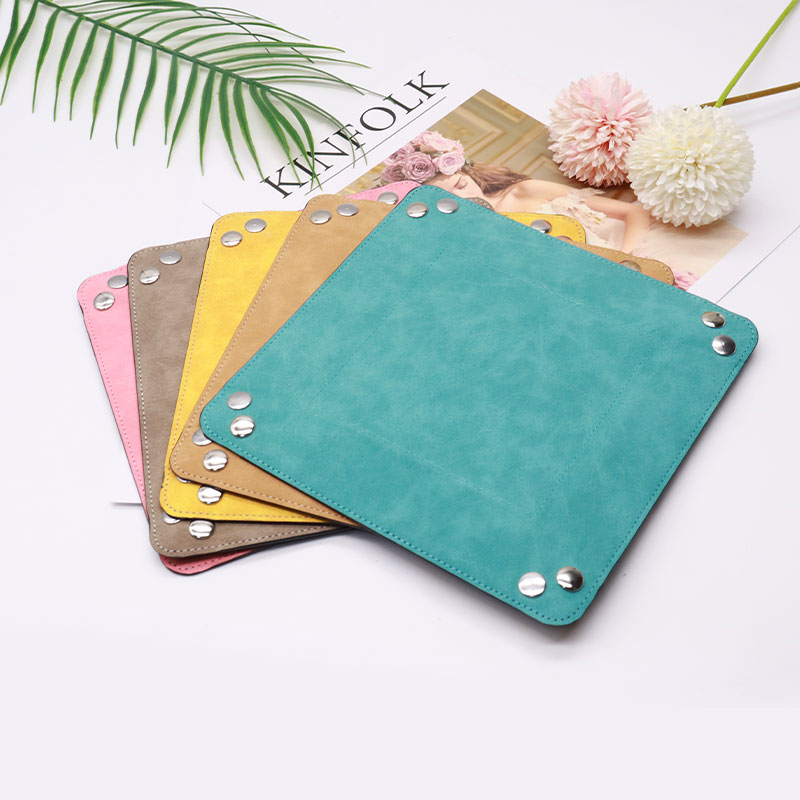
A sublimation leather tray is a flat, coated panel that folds into a shallow open box. In its shipped state it is a single die-cut piece roughly the size of a tablet; the buyer pops the four corners up and the tray holds its shape. That flat-pack trick is the whole commercial appeal: a 25 cm tray ships as a thin panel, so a carton holds four to five times more units than the same tray shipped assembled, and freight per unit drops accordingly.
Construction starts with the substrate. Most trays use a white PU leather face laminated to a rigid board core — typically 1.2 to 1.8 mm greyboard — with a softer backing layer. The board gives the tray its flatness and its ability to stand up when folded; the PU face carries the sublimation coating that accepts dye-sublimation ink. Under heat, the ink turns to gas and bonds into the polyester component of the coating, so the artwork becomes part of the surface rather than a film sitting on top of it. That is why a properly pressed tray survives coffee rings, hotel housekeeping wipes, and daily handling without peeling.
The fold lines are the engineering. Each crease is pressed into the panel with a creasing rule that compresses the board without cutting the PU face; if the crease is too shallow the corners will not close, and if it is too deep the coating cracks along the fold and the ink flakes there first. Corner retention is handled two ways: snap buttons, which give an audible click and a firm hold but add assembly cost, or magnets, which close flatter and look cleaner but depend on magnet grade and pocket depth. A 10 mm neodymium disc set into a recessed pocket holds far better than a thin magnetic sheet, and buyers should ask which one they are getting.
The base separates good trays from cheap ones. Two builds dominate: a full PU base, where the coated leather continues across the bottom for a seamless luxury look, and an oxford fabric base, where a woven fabric panel is stitched to the PU walls for abrasion resistance and a lower price point. Full PU photographs better and suits jewelry and hotel use; oxford fabric survives keys, coins, and EDC gear without scuffing. The inner bottom panel is usually left unprinted because it is the panel customers see most — which makes it the single best place for a logo, a monogram, or a subtle pattern.
Mistake 1: Never testing corner retention. A tray that folds up in the showroom can still collapse when a hotel guest drops a watch and a room key into it. Ask for the retention spec — a snap button should resist a pull of roughly 2 to 3 kg, and a magnet corner should not separate under a 1.5 kg load at the wall. Fold and unfold a sample 50 times and watch whether the crease softens.
Mistake 2: Designing artwork that crosses a crease. The four fold lines cut straight through the printable face. A logo placed 8 mm from a crease will distort when the tray folds, and a full-bleed border will show a white sliver at every corner. Design inside the safe zone your supplier provides, or plan the artwork so pattern break at the crease looks deliberate rather than accidental.
Mistake 3: Specifying a base that cannot hold weight. Trays get loaded with keys, wallets, watches, and phones. A 1.2 mm board with an unsupported base bows within weeks; 1.5 mm board with a doubled base panel stays flat. If the tray is destined for hotel desks or retail display, request a load test — 2 kg distributed across the base for 24 hours with no measurable sag.
Mistake 4: Ignoring how the tray ships. Flat-packed trays ship with creases under tension. Sent loose in a poly bag, corners arrive with curled edges and scuffed PU faces; sent with a printed belly band or a tissue interleaf, they arrive flat and presentable. For retail, ask whether the tray can ship with a hang tag or a printed sleeve, because unboxing is part of the product.
Retail and e-commerce sellers should start with one square tray and one hexagon tray in a mid-size around 20 to 24 cm. Square reads as desk organization, hexagon reads as jewelry and vanity, and the pair covers most gift searches. Printed inner bottoms lift perceived value at almost no cost, and flat-pack shipping keeps dimensional weight low enough for free-shipping thresholds.
Hotels and hospitality buyers need deeper walls, a heavier base, and a surface that survives disinfectant wipes. Specify 1.8 mm board, oxford or sealed PU base, and edge treatment that will not lift after cleaning. A tray in the entryway for keys and cards, plus a smaller one on the desk for watches and coins, is the standard two-piece amenity set.
Corporate and event gift buyers use flat trays as welcome-kit bases: the tray holds a notebook, a pen, and a card holder, and the printed inner panel carries the brand. Large-format printing across the whole panel turns the tray into the packaging and the gift at once, which is why HR and event teams order them in the thousands.
Wholesale and resale buyers should focus on fold consistency and carton economics. Ask for the folded dimension, the flat dimension, and units per carton; a 2 mm difference in folded height changes how many trays fit a master carton and quietly rewrites the landed cost.
| Spec | Entry level | Standard retail | Premium / hotel |
|---|---|---|---|
| Face material | 0.6 mm PU, thin coating | 0.8–1.0 mm PU, roll-coated | 1.0–1.2 mm PU, dense coating |
| Board core | 1.2 mm greyboard | 1.5 mm greyboard | 1.8 mm greyboard, doubled base |
| Corner hardware | Thin magnet sheet | Snap buttons or 8 mm magnets | 10 mm neodymium in recessed pocket |
| Base | Oxford fabric, single layer | Oxford fabric or PU | Full PU, seamless bottom |
| Edge finish | Cut edge | Painted or bound edge | Painted edge plus stitching |
| Print zone | Top face only | Top face and inner bottom | Full face, inner bottom, outer walls |
| Load test | None | 1.5 kg / 24 h | 2 kg / 24 h, no measurable sag |
Full-panel printing instead of a logo patch. Buyers are moving away from a small printed logo on a plain tray toward edge-to-edge artwork — marble, terrazzo, botanical line work — because a fully printed tray photographs like a design object and earns a higher price on marketplaces. That shift puts pressure on coating uniformity, since any density variation shows up across a large flat field.
Recycled board and water-based coating requests. EU corporate buyers now ask for recycled greyboard cores, REACH-compliant adhesives, and water-based receiving coatings as standard tender requirements. Suppliers who can document material composition and provide current test reports win those programs; those who cannot are filtered out at the sample stage.
Set-based merchandising. Trays are increasingly sold as two- or three-piece sets that nest for shipping — a large entryway tray, a medium desk tray, and a small jewelry tray — often bundled with a keychain or a card holder from the same material family. Sets raise average order value and justify a gift box.
Case 1: A hotel group standardizing 8,000 entryway trays across 14 properties. The group's previous supplier shipped trays that arrived with curled corners and PU faces scuffed from loose packing, and housekeeping reported that magnet corners separated when guests dropped room keys and phones in at once. We rebuilt the spec around a 1.8 mm core with a doubled base, replaced the magnet sheet with 10 mm neodymium discs seated in recessed pockets, and added a 60-second crease-and-release cycle to the inspection plan, sampling 40 units per batch. Packing changed to flat trays with tissue interleaves and a printed belly band. Corner separation complaints dropped to zero across the first three properties that went live, and the group rolled the spec out to the remaining eleven.
Case 2: A US gift retailer cutting tray returns from 11% to under 3%. The retailer sold full-bleed printed trays and kept getting returns with white slivers at the corners and ink lifting along the fold lines. The root cause was artwork running into the crease combined with an under-cured coating. We supplied artwork templates with a 6 mm safe zone inside every crease, re-coated the panels on our roll line with a denser base layer, and pressed test units at 195°C for 55 seconds to confirm no cracking after 200 fold cycles. The next production run of 5,000 trays shipped with zero corner-sliver complaints, and the retailer standardized on one press recipe across three tray shapes.
Shenzhen Casta Leather Co., Ltd builds trays on the same leather-goods lines as our notebooks, card holders, and luggage tags, which matters here because a tray is a folding leather product before it is a printed one. For this category specifically, our relevant capabilities are matched die-cutting and creasing that hold panel dimensions within a fraction of a millimeter, in-house corner hardware assembly with pull-tested snap buttons and recessed magnets, and roll-coated white panels that press evenly across a large flat field. We also finish edges — painted or bound — so a folded tray reads as a leather accessory rather than a printed board. Because trays, keychains, and card holders come off the same material family, buyers can assemble matched desk sets from one supplier under one quality standard. The full tray range is at https://www.cncasta.com/.
Our sequence is built around the two things that break trays: creases and corners. First, material qualification: PU rolls are checked for thickness consistency, surface smoothness, and heat stability before laminating to greyboard. Second, lamination and coating: board and face are bonded under controlled pressure, then the receiving layer is roll-applied and density-checked per batch so a large printed field stays even. Third, die-cutting and creasing: panels and crease lines are cut in one matched operation, with crease depth set so the coating does not crack; artwork safe zones are generated from the same file. Fourth, hardware: snap buttons are pressed with a set force and magnets are seated in recessed pockets at a fixed depth, then sampled for pull force. Fifth, fold testing: 40 units per batch are folded and unfolded 50 times and checked for crease whitening, corner gap, and edge lift. Sixth, packing: trays ship flat with tissue interleaves, optional printed sleeves or belly bands, and a load-tested base confirmed at 2 kg for 24 hours on premium specs.
Start at 190°C for 50 to 60 seconds at medium pressure, with a protective sheet over the artwork and the panel flat. Large solid-color fields need uniform pressure more than extra time; if you see mottling, check platen flatness before adding temperature. Our trays are validated at 200°C for 60 seconds, so there is headroom before any yellowing.
Snap buttons hold harder and survive rough handling, which suits hotel and family use. Recessed 10 mm neodymium magnets close flatter and look cleaner, which suits retail and gift packaging. Thin magnetic sheets are the one option to avoid — they lose grip after a few dozen folds and are the most common cause of a tray that will not stay up.
Yes, and it is the panel most worth printing because customers look at it every day. Sublimated ink bonds into the coating rather than sitting on the surface, so it does not rub off in normal use; we still run a wet-wipe and 100-cycle flex test on the inner panel for hotel programs where disinfectant cleaning is routine.
Standard shapes and sizes ship from stock. Custom die shapes, printed inner panels, and logo programs typically start in the low hundreds of pieces per design, with prototypes in about seven working days and bulk production in three to four weeks depending on finishing. Send your artwork and target quantities to yinjinfeng@szcasta.com or call +86 18675583959 (WhatsApp available) for a quote.
Shenzhen Casta Leather Co., Ltd
Hotline : +86 18675583959 (WhatsApp available)
E-mail : yinjinfeng@szcasta.com
Room 101, Unit 1, No.36 Ainan Road, Longdong Community, Baolong Subdistrict, Longgang District, Shenzhen City
Website: https://www.cncasta.com/


