

If you are buying sublimation leather notebooks in bulk for schools, offices, or corporate gift programs, the two decisions that matter most are the binding style and the print quality of the cover. A sewn-bound notebook survives daily page-turning, while a loose-leaf binder lets users refill and reorganize. This guide compares both formats, explains which coating and pressing settings produce ghost-free covers, walks through a step-by-step DIY printing process, and shows how Shenzhen Casta Leather Co., Ltd pre-tests every notebook batch so your brand logo lands clean on the first order.
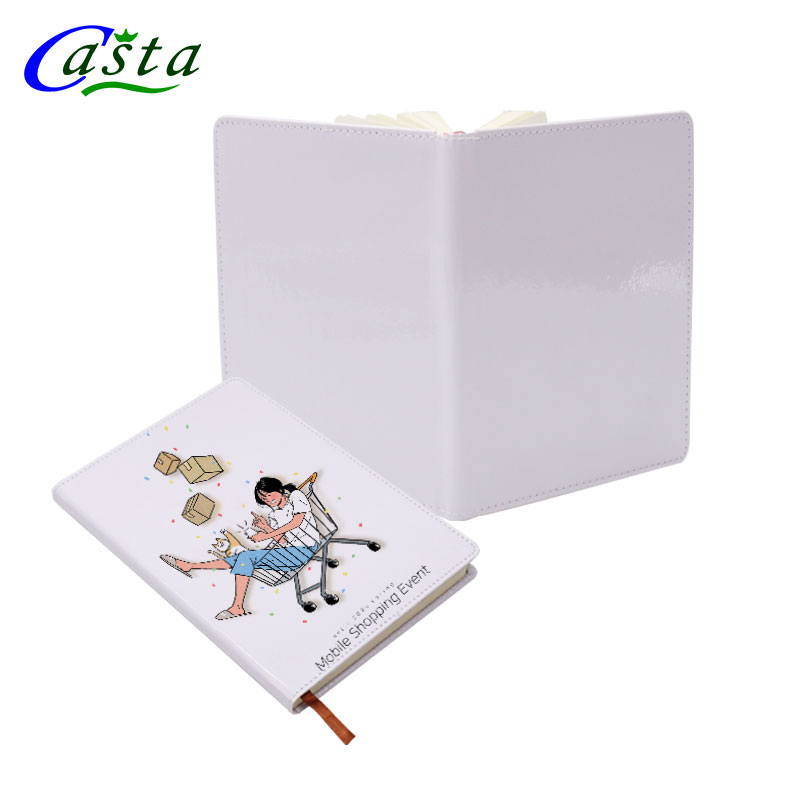
A sublimation leather notebook is a PU or faux leather cover — in A4, A5, or A6 formats — laminated with a polyester coating that accepts dye-sublimation ink. At 180–200°C the ink turns to gas and bonds into the coating, so the design sits inside the surface rather than on top of it. That is why a sublimated cover survives keys, coins, and daily bag wear far better than a printed sticker or screen-printed decal.
Inside, the block is usually sewn-bound with a fabric or PU spine, glued for slim diaries, or built as a loose-leaf binder with a metal ring mechanism. Elastic pen loops, ribbon markers, and elastic closure bands are added at the assembly stage. Because the cover is die-cut and coated in-house, buyers can order custom artwork per campaign instead of committing to thousands of copies of a single design.
Mistake 1: Choosing binding by price alone. A glued block costs less but can shed pages after a semester of hard use. For school programs and staff onboarding kits, sewn binding pays back in perceived quality.
Mistake 2: Ignoring coating weight. Covers with a thin or uneven coating transfer weakly, especially on full-bleed photographic artwork. Always ask how the supplier verifies coating uniformity across a batch, not just on the sample.
Mistake 3: Skipping the blank test before a bulk order. Press one blank from the actual production batch, not from the sample kit. A batch pressed with inconsistent lamination will ghost no matter how good your artwork is.
Mistake 4: Reheating to fix a bad transfer. Running the same sheet through the press twice almost always produces a ghost outline. If the first press fails, discard the blank and diagnose the cause — pressure, moisture, or time — instead of re-pressing.
Retail and e-commerce sellers usually pick A5 sewn-bound notebooks with trendy full-wrap artwork. The A5 format hits the most common price point and ships flat.
School and university programs favor A6 sewn-bound blocks with elastic closures — compact, durable, and cheap enough to cover an entire cohort with a student council logo.
Corporate gift programs prefer A5 or A4 loose-leaf binders for onboarding kits: HR can insert policy pages, calendars, and branded dividers that employees can replace during the year.
Wholesale resellers and print shops stock blank covers in mixed sizes, print client artwork locally, and rely on the supplier for consistent coating so their own presses produce identical results order after order.
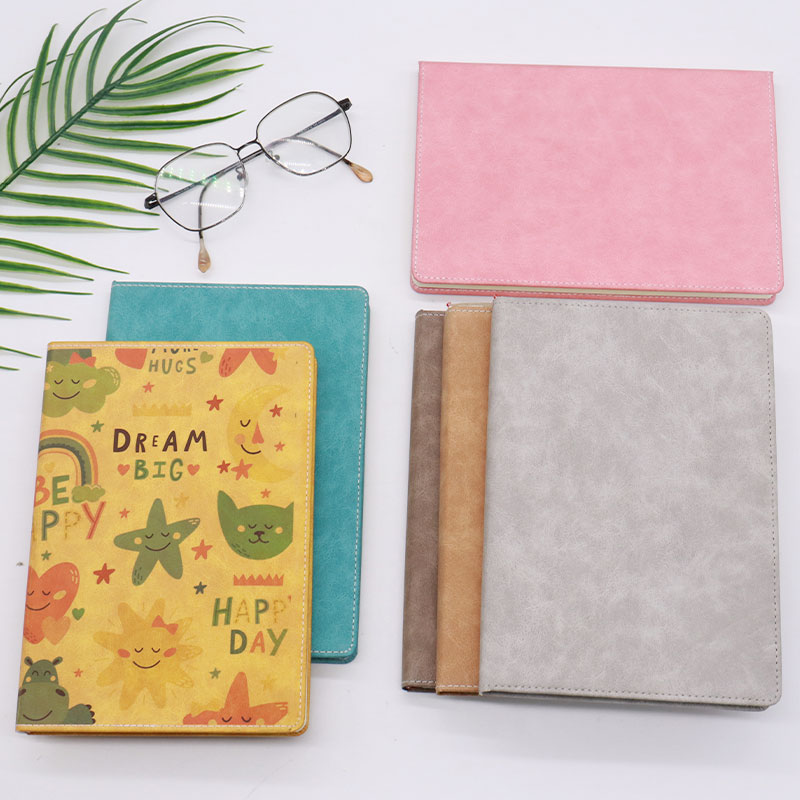
| Format | Binding | Best use | Custom logo MOQ |
|---|---|---|---|
| A6 sewn-bound | Sewn fabric spine | School giveaways, event handouts | Low hundreds per artwork |
| A5 sewn-bound | Sewn spine + elastic band | Retail, staff gifts, conference kits | Low hundreds per artwork |
| A5 loose-leaf | Metal ring binder | Refillable planners, HR onboarding | About 500 with tooling |
| A4 loose-leaf | Metal ring binder | Folders, proposals, training packs | About 500 with tooling |
Prototypes for any of the four formats are typically ready in about seven working days, and bulk production runs three to four weeks depending on binding and finishing.
Paired product sets. Notebooks now ship as sets with matching pen loops, fabric bookmarks, and sticky note holders printed from the same artwork file — one press run covers the whole kit, which lifts perceived value without adding SKU complexity.
Water-based coated PU. Buyers in the EU increasingly ask for lower-solvent coating systems; the newer water-based PU covers sublimate identically but carry a friendlier compliance story for retail packaging.
Quiet matte textures. Glossy covers are losing shelf appeal; matte textured PU hides fingerprints and presses slightly longer — about 5 seconds more — to reach the same ink density.
Case 1: A UK stationery brand fighting ghosting on dark covers. The client's previous supplier shipped a batch of navy A5 covers that ghosted on full-bleed white typography. We reproduced the issue on a sample press at 185°C/50s, then traced it to uneven coating weight near the spine fold. Casta Leather re-coated the panel stock with a verified gram-weight tolerance, ran a three-press validation matrix (185°C/50s, 190°C/55s, 195°C/60s) on blanks from the first production batch, and locked the client's recipe at 190°C/55s. The reorder went out with zero ghost complaints and the client moved its full notebook line to us.
Case 2: A German automotive dealership onboarding kit. The client needed 1,200 A5 loose-leaf binders with a debossed logo on the front panel and sublimated interior flaps printed with the service-center map. We debossed a steel-die logo sample in five days, printed the flap artwork as a proof card, and assembled pen loops from matching PU trim. Prototypes were approved on the second round, and the full order shipped flat-packed with the ring mechanisms pre-set, letting the dealership insert its HR pages in-house before the event.
Shenzhen Casta Leather Co., Ltd controls the whole notebook chain in one facility: PU panel coating with batch-level gram-weight checks, die-cutting, sewn or ring-bound assembly, and press validation before shipment. That matters for notebooks more than for flat blanks, because a notebook's spine fold is exactly where coatings tend to thin out and ghosting starts. Buyers get per-batch press test records, low-MOQ custom logo runs starting in the low hundreds per artwork, and format flexibility from A6 pocket diaries to A4 ring binders — all listed with current product ranges on https://www.cncasta.com/.
Consistent coating, consistent print. Because coating is applied and measured in-house, your tenth reorder prints like the first — the single biggest cost saver in local sublimation production.
Low MOQ with real customization. Debossed or heat-pressed logos, custom inner flaps, and elastic closure colors start from a few hundred pieces per design, not the five-figure minimums typical of full-custom stationery.
Tested before it ships. Batch-level press tests, flex tests at the spine, and hardware pull tests mean the kit you unpack is the kit you approved.
Yes. Debossing and foil stamping work directly on the PU cover and pair well with sublimated artwork on the same notebook — debossed logo on the front, full-color artwork inside the flaps. Logo programs start from a few hundred pieces per design.
Start at 185°C for 50–60 seconds at medium pressure with the print face up and a protective sheet; dense artwork may need 5–10 extra seconds. We validate every notebook batch at 200°C/60s so you have headroom without yellowing the cover.
Both are durable when built properly. Sewn blocks with lock-stitch thread outlast glued blocks; ring binders last as long as the mechanism quality, which is why we use reinforced punch spacing. For refillable programs, loose-leaf wins because users replace pages instead of notebooks.
Prototypes in about seven working days, bulk production in three to four weeks depending on binding and finishing. Send artwork and quantities to yinjinfeng@szcasta.com or call +86 18675583959 (WhatsApp available) for a quote and coating data sheet.
Shenzhen Casta Leather Co., Ltd
Hotline : +86 18675583959 (WhatsApp available)
E-mail : yinjinfeng@szcasta.com
Room 101, Unit 1, No.36 Ainan Road, Longdong Community, Baolong Subdistrict, Longgang District, Shenzhen City
Website: https://www.cncasta.com/


