

A Faraday bag is the lightest, cheapest, and most portable way to cut off a key fob, phone, or card from every radio around it — but only if the shielding, closure, and lining are engineered properly. Most bags sold online leak signal at the seams or fail after weeks of daily use. This guide explains how Faraday bags block signals across different bands, which materials and closure types hold up in real use, how to run a no-service and call test before trusting one, and how Shenzhen Casta Leather Co., Ltd manufactures, tests, and customizes Faraday bags for retailers, car dealerships, and insurance campaigns at wholesale scale.
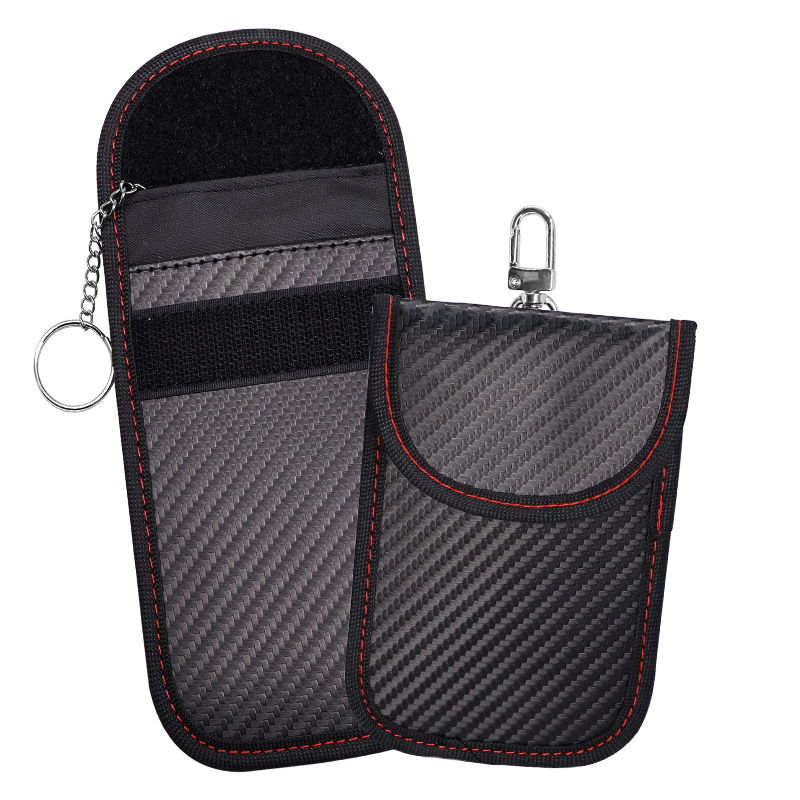
A Faraday bag is a flexible pouch built like a soft Faraday cage. Between the outer fabric and the inner lining sit one or more conductive layers — typically a metal-fiber textile, a carbon-fiber weave, or a laminated shielding film. Radio waves hitting the bag induce currents in the conductive layers that dissipate the energy across the surface, so nothing reaches the antenna inside. A key fob in a working Faraday bag cannot answer a relay attack device; a phone inside loses service within seconds; an RFID credit card stops responding to skimmers.
Shielding effectiveness is the number that matters, expressed in decibels. Professional-grade bags target 60 dB or higher from roughly 10 kHz to 3 GHz. That range covers the 315 MHz and 433 MHz bands car fobs use, the 13.56 MHz band of contactless cards, Bluetooth at 2.4 GHz, GPS, and most cellular bands. Bags that only shield RFID card frequencies are fine for wallets but useless for key fobs — check which bands the supplier actually tests.
Construction quality separates bags that work for years from bags that work for a month. The conductive layer must wrap the entire interior with overlapped seams, and the closure is the critical point: a hanging-snap flap or magnetic closure that pulls the shielded faces into continuous contact keeps the cage closed, while a loose top opening leaks signal like an open window. Because users open and close these bags daily, stitching, edge sealing, and closure hardware all need real durability — which is why leather goods factories, not bag drop-shippers, tend to produce the versions that survive.
Mistake 1: Buying untested pouches from spec sheets. "Blocks all signals" is not a specification. Ask which frequency bands were tested, at what attenuation, with what method — and then test a sample yourself: put a phone inside, close the bag, and call it. If the phone rings, walk away. For key fobs, place the fob inside and press the car door handle.
Mistake 2: Choosing the wrong closure for the use case. Magnetic closures are fastest for daily fob use at home; hanging snap closures with a belt loop or carabiner suit people who carry the pouch; zipper closures seal fully but add cost and can abrade the lining over time. A closure the user finds annoying is a closure that stays open — and an open Faraday bag blocks nothing.
Mistake 3: Ignoring single versus double-layer shielding. Double-layer bags shield on both the flap and the body, so the closed bag forms a complete cage. Single-layer designs with an unshielded flap rely entirely on overlap, and the overlap degrades with wear. For key fobs and phones, insist on double-layer construction.
Mistake 4: Ordering one size for everything. A fob pouch is too small for a phone; a phone bag is wasteful for a single card. Retailers should stock a small range — fob size, phone size, and a large document or tablet size — and buyers running corporate campaigns should match the bag size to what recipients actually carry daily.
Retail and e-commerce sellers should build around family multi-packs: four to six pouches in mixed sizes with one shared design language. Multi-packs raise order value, solve the "one bag per fob" household problem, and photograph well. Carbon-fiber texture sells to the tech-minded buyer; PU leather in black or brown sells to the premium gift buyer.
Car dealerships and automotive brands get the most value from a single premium pouch included in every new-car handover. A PU leather Faraday bag with a debossed logo costs little at volume and keeps the brand in the customer's pocket every day. Pair it with a branded Faraday box for the home entryway and the anti-theft story is complete.
Insurance companies and fleet operators buy in volume as education merchandise. For these campaigns, uniform batch quality and clear usage instructions matter more than premium materials — every unit must pass the same fob test, and the packaging should explain the relay-attack problem in one diagram.
Wholesale and distributor buyers should consolidate with one manufacturer across fob, phone, and document sizes to keep shielding specs and QA identical across the range. Mixing suppliers for different sizes almost guarantees inconsistent test results within one catalog.
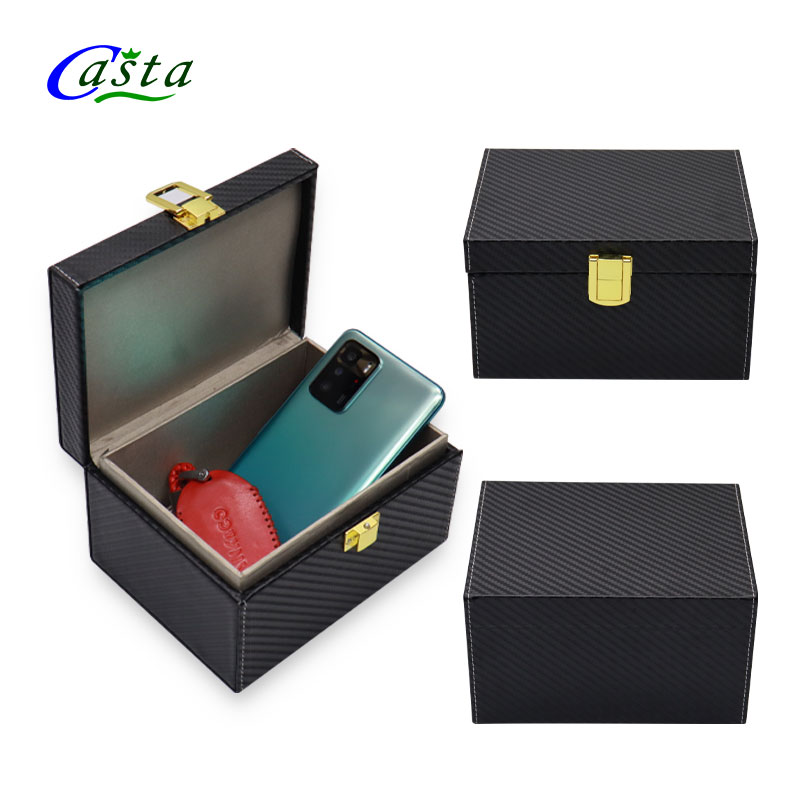
EMI/EMF awareness drives phone-sized bags. Beyond anti-theft, more consumers buy Faraday bags to reduce phone radiation exposure at night and to protect devices from EMP concerns. Phone-size bags with inner pockets that separate the phone from cards are becoming a standard SKU, and listings increasingly show a live "no service" test video.
Waterproofing becomes a default expectation. Buyers now treat the bag as both a shield and everyday carry, so outer fabrics with water-repellent coating and welded or well-sealed edges are moving from premium feature to baseline requirement, especially in the UK and Nordics where relay theft and rain coexist.
Corporate branding shifts to subtle finishes. Insurance and automotive buyers want pouches that recipients actually keep using, so matte PU leather with tone-on-tone debossing is replacing glossy printed logos. A bag that looks like a leather accessory stays in daily rotation; a bag that looks like a giveaway ends up in a drawer.
Case 1: A Nordic insurance company shipping 8,000 pouches to policyholders. The client's first supplier failed field tests — 6% of sampled pouches let fobs unlock cars, traced to a shielding layer that stopped short under the flap. We rebuilt the pattern with full double-layer shielding, a magnet-aligned flap that pulls the shielded faces flat together, and edge binding that protects the seam from daily flexing. We then ran a live fob test on 120 units per batch — fob inside, door-handle press, no response — and archived the results per carton. The campaign shipped in three tranches over five weeks, the complaint rate stayed under 0.3%, and the client standardized on the same pouch for a two-year program.
Case 2: A US car dealership group branding pouches for handover kits. The buyer wanted 2,500 PU leather Faraday bags with a debossed logo, sized for one fob plus a garage remote, delivered before a quarterly sales event. We prototyped two closure options in five working days — magnetic flap versus hanging snap — and the client chose the magnetic flap after a two-week staff trial. We matched the deboss depth to their artwork so the logo stayed crisp on soft PU, ran a first-article color approval, and finished production in 18 days. Each pouch shipped flat in an individual poly bag with an instruction insert. The group reordered at 4,000 units for its second brand the following quarter.
Shenzhen Casta Leather Co., Ltd brings leather-goods manufacturing discipline to a category full of poorly finished pouches. For Faraday bags specifically, our relevant strengths are precise shielding lamination with overlapped seams, durable PU leather and fabric exteriors stitched on production lines that also make our notebook and keychain collections, and closure hardware selected for daily-cycle durability. We support carbon fiber, oxford fabric, and PU leather builds across fob, phone, and document sizes, and we test live fobs and phone calls on production batches so shielding is verified, not claimed. Current bag models, sizes, and customization options are listed at https://www.cncasta.com/, and we encourage buyers to fail-test samples themselves before ordering.
Our production method runs the same disciplined sequence on every bag order. First, material qualification: shielding fabric rolls are inspected for continuity, and outer materials are checked for coating weight and color consistency. Second, pattern engineering: panels are cut so the conductive layer wraps the interior with planned overlaps at every seam and under the flap — the geometry that decides real-world attenuation. Third, lamination and assembly: shielding layers are bonded without wrinkles that could create air gaps, and the scratch-safe inner lining is installed. Fourth, closure assembly: magnets or snaps are seated with consistent pull force so every unit closes with the same feel and full contact. Fifth, stitching and edge finishing: stress points like the flap hinge and loop attachments get reinforced stitching. Sixth, batch testing: sample units from each batch face a live 315/433 MHz fob test and a phone call test — no unlock, no service — with results recorded per batch. Finally, packing: bags ship flat with instruction cards, and a pre-shipment inspection samples closure cycles and seam integrity before cartons are sealed.
Run two tests. Phone test: put a phone inside, close the bag, and call it from another phone — no ring means the cellular band is blocked. Fob test: place the key fob inside, close the bag, and press the car door handle — no response means the fob band is blocked. Repeat after a month of daily use, because cheap bags degrade at the closure first.
A double-layer bag with 60 dB+ shielding across 10 kHz–3 GHz stops cellular, Wi-Fi, Bluetooth, and GPS, so the phone shows "no service" while inside. This is why the bag also works for EMI/EMF-conscious users and for devices that must stay silent during meetings or travel.
Yes. Debossed or heat-pressed logos on PU leather, custom dimensions, and branded instruction cards all start from a few hundred pieces per design. Send artwork to yinjinfeng@szcasta.com or reach us at +86 18675583959 (WhatsApp available) for sampling timelines.
With double-layer shielding, reinforced flap stitching, and cycle-tested closures, a well-made bag holds its shielding performance for years of daily opening and closing. The failure points on cheap bags — loose closures and worn seams — are exactly the details we control in lamination, assembly, and batch testing.
Shenzhen Casta Leather Co., Ltd
Hotline : +86 18675583959 (WhatsApp available)
E-mail : yinjinfeng@szcasta.com
Room 101, Unit 1, No.36 Ainan Road, Longdong Community, Baolong Subdistrict, Longgang District, Shenzhen City
Website: https://www.cncasta.com/


