

A sublimation luggage tag is one of the highest-margin personalization products a print shop or gift brand can sell: small, cheap to ship, endlessly customizable, and useful every time the customer travels. But small-format sublimation is unforgiving — tiny text blurs, privacy flaps print on the wrong side, and cheap tags fade after one checked-bag handling. This guide explains what separates a professional PU leather sublimation luggage tag from a bargain one, how to print small formats cleanly, which specs matter for checked-luggage durability, and how Shenzhen Casta Leather Co., Ltd produces, tests, and customizes luggage tags for travel brands, airlines, and corporate gift programs.
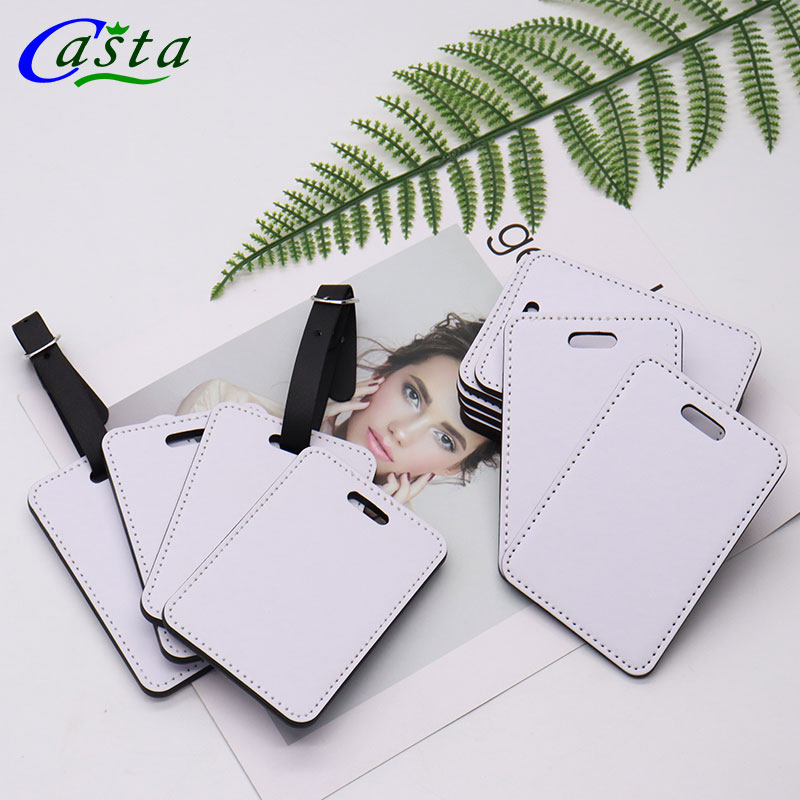
A sublimation luggage tag is a small identification tag — typically 10 to 12 centimeters long — made from PU or faux leather with a polyester receiving coating that accepts dye-sublimation printing. Under heat and pressure, sublimation ink turns to gas and bonds with the polyester molecules in the coating, so the artwork becomes part of the surface instead of sitting on top of it. That is why a properly printed tag survives rain, baggage-carousel abrasion, and years of handling, while a screen-printed tag flakes off within a season.
The defining feature of the category is the privacy flap: a cover panel that folds over the clear ID window, so the owner's name, phone, and address are visible to airline staff when opened but hidden from strangers in the terminal. The flap is also the hardest part to manufacture well. The printing panel and the flap are die-cut from the same coated sheet, so the flap's inner face is usually printable too — enabling double-sided designs — but if die-cutting tolerances drift, the flap misaligns with the window and the tag looks cheap immediately.
Hardware completes the product. A tag lives a violent life on checked luggage: it is yanked, crushed, and soaked. The strap loop must be a reinforced leather strip or durable cord riveted through multiple layers — not a thin cord glued through a single punch — and the buckle or metal ring needs pull-test data. On premium tags, edge painting or stitching seals the cut edges so the tag reads as a leather accessory rather than a printed scrap.
Mistake 1: Ignoring flap alignment on samples. Photos hide what a sample reveals in ten seconds: does the flap cover the window completely, does it stay closed, and does the printed inner face line up when folded? Request a physical pre-production sample with your own artwork before bulk — misaligned flaps are the number-one return driver in this category.
Mistake 2: Printing small text below the readable threshold. A luggage tag panel gives you roughly 100 × 60 mm of canvas. Body text below 7 pt and QR codes below 15 mm blur on PU coating. Design with the format in mind: large names, one phone number, one email, and a QR code at least 20 mm. Provide buyers with a print template with 3 mm bleed on all sides so full-bleed designs do not leave white edges.
Mistake 3: Skipping waterproof and abrasion testing. "PU leather is waterproof" is only true when edges are sealed and the coating is properly cured. Test the sample: soak it, wipe it with a wet cloth after pressing, and flex the flap 100 times. A tag whose print dulls after wiping will generate complaints from travelers within weeks.
Mistake 4: Treating straps and hardware as an afterthought. Buyers compare printing quality and forget the attachment point — the single most common failure on cheap tags. Specify riveted leather loops or tested buckle straps, and ask for the hardware pull-test figure before ordering.
Retail and e-commerce sellers should stock a small range: classic rectangle tags with privacy flaps, round tags for a boutique look, and one novelty shape. Double-sided printing doubles perceived value at almost no cost. Bundle tags with passport covers or keychains to raise average order value — travel gift sets consistently outperform single-item listings.
Travel agencies, airlines, and hotels buy tags as branded merchandise: logo on the flap outer, contact or loyalty information inside, sometimes with a QR code linking to booking portals. At volume, consistency matters most — every tag in a 10,000-piece run must press identically, which is a coating QC question, not an artwork question.
Golf and sports brands should look at bag tag plus tee holder combos: a larger tag format with an integrated tee pocket survives bag handling and serves two purposes. These combos command higher prices and differentiate listings from generic tags.
Corporate gift buyers use tags for conference welcome kits and employee travel programs. Custom logo tags in a branded poly bag with an instruction or welcome card turn a two-dollar product into a genuine gift moment.
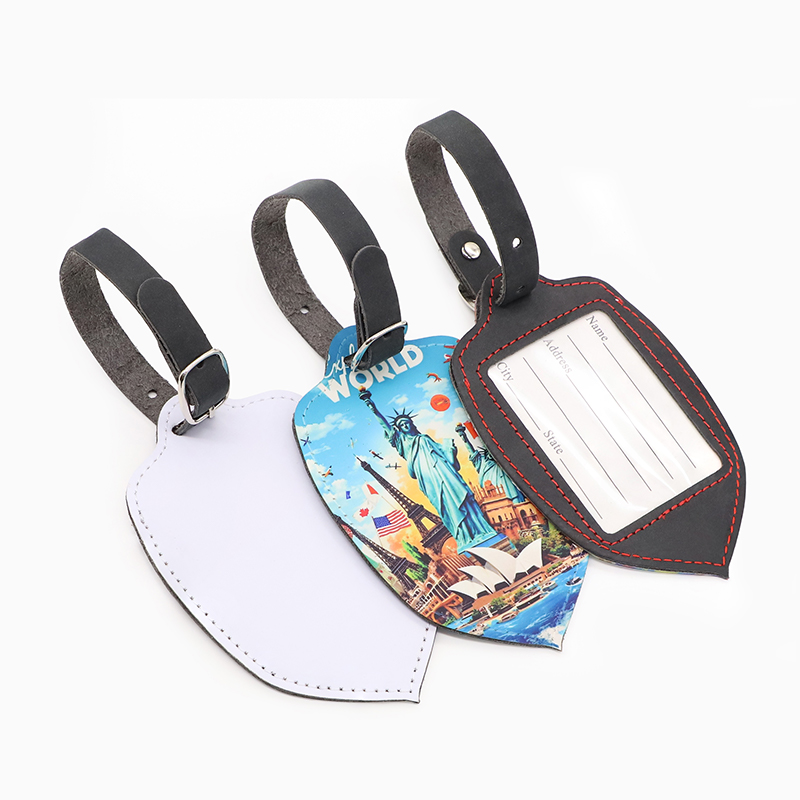
Vintage plaid and patterned substrates. Pre-printed plaid and heritage patterns on the non-printing side let sellers offer two aesthetics from one SKU — a photo design on the front, a classic pattern on the reverse. Patterned tags photograph well and differentiate listings in a crowded category.
QR and digital pairing. More tags ship with a QR code panel linking to digital contact forms or lost-and-found services, and suppliers increasingly print the QR directly in the sublimation artwork. At 20 mm or larger with high contrast, sublimated QR codes scan reliably after years of use.
Eco-material questions. EU buyers now ask about coating chemistry and material compliance on tags as often as on notebooks. Water-based coatings and REACH-compliant adhesives have become a selection criterion for corporate programs, so request current test reports before tendering.
Case 1: A travel agency chain with a 12,000-tag branding campaign. The client wanted full-color tags with their logo on the flap and a QR booking code inside, delivered across three countries in eight weeks. Their previous quote came from a trader who could not confirm flap alignment tolerance. We prototyped in five working days, ran a 50-piece pilot press at 185°C/50s to lock color and QR scan reliability, and set flap alignment as an inspection point — sampling 60 units per batch with a go/no-go gauge. Production finished in 22 days; the QR codes scanned on first attempt on sampled tags, and the agency re-ordered the following season without re-approving artwork.
Case 2: A US gift retailer fixing return rates on double-sided tags. The client bought double-side printable tags from a marketplace supplier and saw complaints that the reverse print showed through and transferred onto passport pages. We diagnosed the issue as an under-cured coating and insufficient layer density. We supplied test samples from our roll-coated line with a denser white base, ran cross-transfer wiping tests at 200°C/60s, and documented zero show-through and zero transfer. Switching our tags cut their category return rate from 9% to under 2% within one quarter, and the consistent white surface let them standardize one press recipe across all tag shapes.
Shenzhen Casta Leather Co., Ltd is a leather goods manufacturer, and luggage tags benefit directly from the craft behind our other sublimation products: precisely die-cut panels, flap assemblies that align because they are cut and folded in the same operation, and edge painting or stitching that makes a tag look like a leather accessory instead of a printed scrap. For this category specifically, our relevant capabilities are roll-coated white panels with batch-level density checks, in-house die-cutting that holds small-format tolerances, and hardware assembly with pull-tested straps and rings. Because we produce the tag, the passport cover, and the keychain on the same lines, buyers can build matched travel gift sets from one supplier with one QA standard. Browse the tag range and set options at https://www.cncasta.com/.
Our production sequence is tuned for small formats, where every tolerance is tighter. First, material selection: white PU leather rolls are qualified for surface smoothness and heat stability before coating. Second, roll coating: the sublimation receiving layer is applied continuously and density-checked per batch, so tag one and tag ten thousand press identically. Third, die-cutting and creasing: panels, flaps, and windows are cut in matched operations so flap alignment stays within tolerance; fold lines are creased without cracking the coating. Fourth, printing support: we provide artwork templates with bleed and safe zones, and for bulk corporate orders we can press the artwork in-house after a color proof approval. Fifth, assembly: flaps close with snaps or magnets seated for consistent closing force, straps are riveted through reinforced layers, and hardware is pull-tested. Sixth, validation and packing: sample tags from each batch are test-pressed at 200°C/60s and inspected for ghosting, edge bleed, and flap alignment before cartons are sealed; tags ship flat with protective interleaves and optional retail packaging.
Start at 185°C for 50 seconds at light-to-medium pressure with the print face up and a protective sheet. Dense full-bleed artwork may need 5–10 extra seconds. Casta Leather validates every tag batch at 200°C/60s, so you have headroom without yellowing.
At least 20 mm with high contrast and a quiet zone — sublimated QR codes at that size scan reliably for years. Below 15 mm, thermal printer-scale codes blur on PU coating. We provide artwork templates with the correct safe zones for every tag shape.
Standard shapes ship from stock; custom logo and double-side designs typically start from a few hundred pieces per artwork, with prototypes ready in about a week. Contact yinjinfeng@szcasta.com or call +86 18675583959 (WhatsApp available) with your artwork for an exact quote.
Yes, when edges are sealed, straps are riveted through reinforced layers, and hardware is pull-tested — all standard on our tags. Our batch validation includes wet-wipe and flex tests on the printed panel, because a tag that fades or peels after one trip is a return waiting to happen. Full product details are at https://www.cncasta.com/.
Shenzhen Casta Leather Co., Ltd
Hotline : +86 18675583959 (WhatsApp available)
E-mail : yinjinfeng@szcasta.com
Room 101, Unit 1, No.36 Ainan Road, Longdong Community, Baolong Subdistrict, Longgang District, Shenzhen City
Website: https://www.cncasta.com/


