

A PU leather backgammon set sits at the intersection of a classic game and a modern gift: it folds or rolls flat for travel, looks premium in the hand, and carries a brand on its surface. Yet most buyers underestimate how much craft separates a set that survives a camping trip from one that cracks at the hinge after a month of use. This guide walks through roll-up versus folding designs, playing-surface materials, the hardware that keeps a set closed, and how Shenzhen Casta Leather Co., Ltd builds, tests, and custom-brands backgammon sets for corporate gift programs and retail buyers across the US and EU.
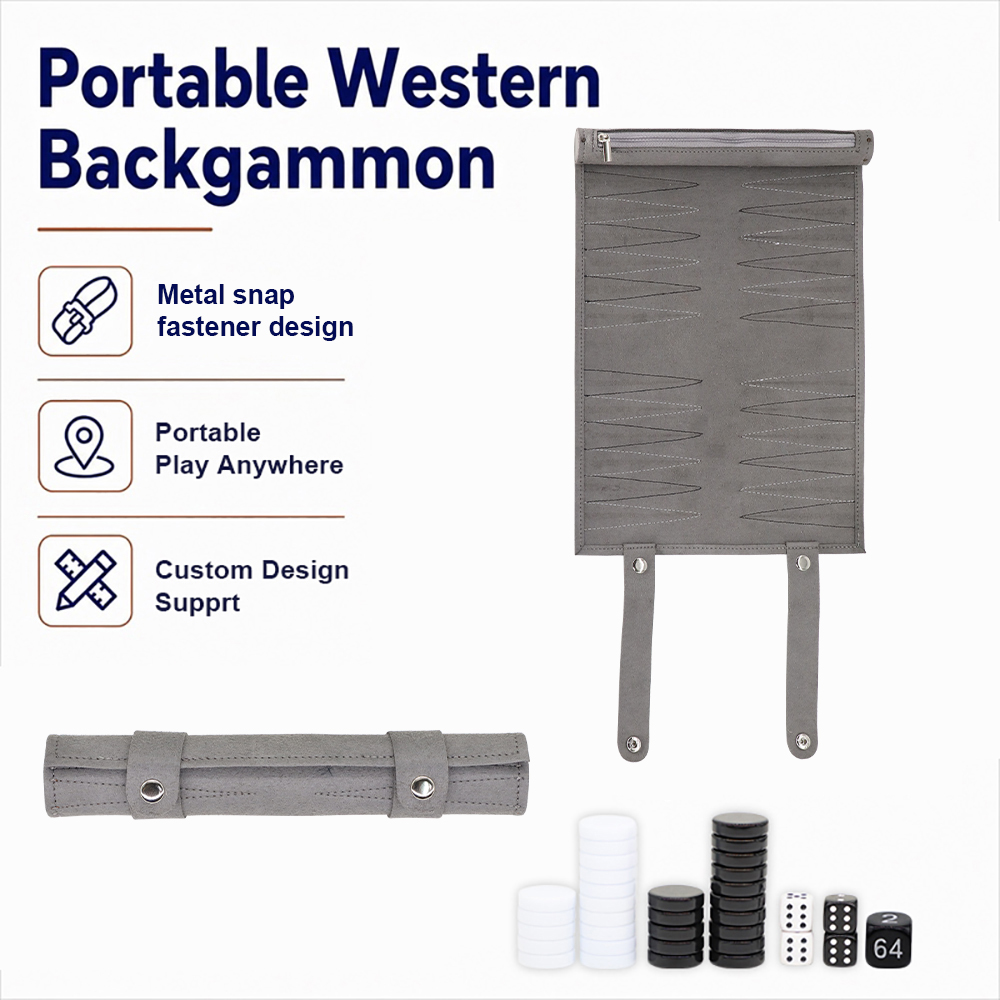
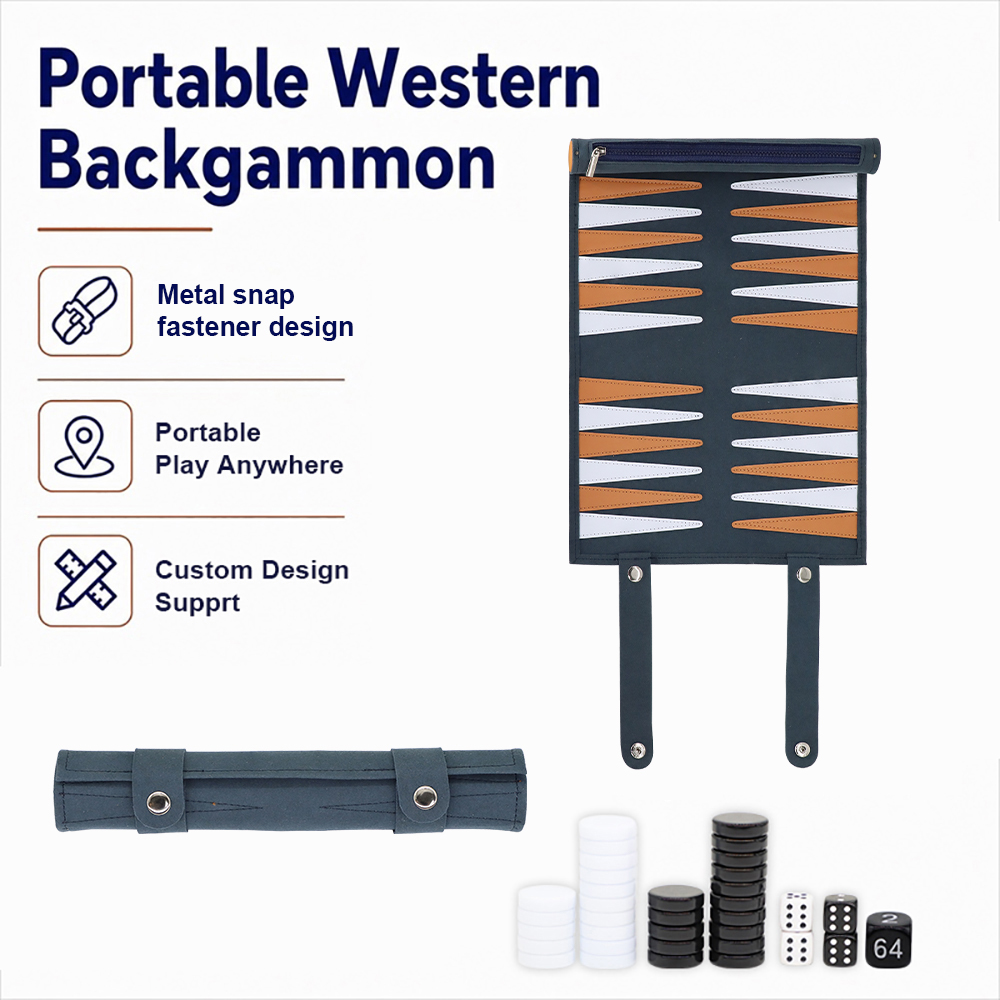
A backgammon set is one of the oldest two-player board games, and in its leather form it is a travel-friendly case that opens into a 24-point playing field. The construction starts with the panel: a coated PU leather face laminated to a 1.5 to 2.0 mm greyboard core, which gives the board its flatness and lets it fold without curling. The playing field is printed or debossed onto that face, then a thin clear overlay or a bonded microfiber surface is applied so the checkers slide without tearing the print.
Two designs dominate. The roll-up board is a flat panel closed with a strap and snap or buckle; it is the lightest and cheapest to ship, and it rolls around the pieces like a small mat. The book-fold board is a rigid case that opens like a notebook, with the two halves hinged along the center line and a zippered or snapped compartment for the 30 checkers, two dice, and the doubling cube. The hinge is the engineering detail that matters most: a stitched fabric spine holds longer than a creased PU fold, and a hidden reinforcement strip stops the center line from splitting after repeated opening.
The playing pieces are standardized. Each side uses 15 checkers of roughly 30 mm diameter, traditionally in two contrasting colors; we mold them from resin or press them from PU discs so they stay light for travel. The dice are 16 mm acrylic with engraved pips, and the doubling cube is a smaller marked block used to raise the stakes. All of these pieces must fit the storage pocket with at least 5 mm clearance, or the zip strain will eventually split the seam.
Mistake 1: Choosing a creased hinge instead of a stitched spine. A board that simply folds the PU along the center line will crack the coating within a few dozen opens, and the print across the fold flakes first. A stitched fabric hinge with a reinforcement strip survives thousands of cycles. Ask how the hinge is built, not just how it looks on day one.
Mistake 2: Specifying a playing surface that scuffs. Bare printed PU scratches under moving checkers, and a thin microfiber layer pills after a season. A bonded PU-felt surface or a sealed clear overlay keeps the field readable and the checkers moving smoothly. For branded corporate sets, a sealed surface also protects the logo from handling oils.
Mistake 3: Under-specifying the closure hardware. A magnetic snap that is too weak pops open inside a backpack and spills 30 checkers across an airport floor. Specify spring snaps rated for repeated use or a zip with a pull rated for at least 5 kg of tug, and test the closure with the pieces inside before approving bulk.
Mistake 4: Printing artwork across the fold line. The center hinge runs straight through the playing field. A logo or border placed on the centerline distorts when the board closes and looks misregistered on a flat lay. Keep the brand mark in a corner panel or the storage flap, away from the hinge and the point triangles.
Corporate gift and client-appreciation buyers should choose a book-fold case in 1.8 to 2.0 mm PU with a debossed or foil logo on the cover and a zippered piece pocket. These are handed to executives and partners, so the set must feel substantial and close silently; a magnetic snap with a fabric hinge and a printed field inside reads as premium without a high unit cost.
Travel, outdoor, and camping retailers need the roll-up strap design. It weighs little, rolls into a 5 cm tube, and survives being stuffed into a rucksack. Specify a PU-felt surface that resists scuffing and a buckle strap rather than a snap, because straps hold better under compression in a packed bag.
Family and game-night buyers want a larger board, typically 38 to 45 cm open, with high-contrast point triangles and chunky checkers that are easy to pick up. Here the playing surface and checker grip matter more than portability, so a sealed overlay over a printed field is the right call.
Promotional and trade-show giveaways use a compact 28 to 32 cm set with a screen-printed logo and a simple snap closure. Volume and price drive the decision, but the hinge and closure still need to survive shipping and handling, so do not strip the reinforcement to save a few cents.
| Spec | Roll-up travel | Book-fold gift | Family large | Promo compact |
|---|---|---|---|---|
| Panel core | 1.5 mm greyboard | 2.0 mm greyboard | 2.0 mm greyboard | 1.5 mm greyboard |
| Open size | 30–34 cm | 34–38 cm | 38–45 cm | 28–32 cm |
| Surface | PU felt | Sealed overlay | Sealed overlay | Printed PU |
| Hinge | Strap rolled | Stitched fabric spine | Stitched fabric spine | Creased with strip |
| Closure | Buckle strap | Magnetic snap + zip | Snap + zip | Spring snap |
| Checker size | 28 mm | 30 mm | 32 mm | 26 mm |
| Typical MOQ | From 300 | From 300 | From 200 | From 500 |
Custom branding as standard, not premium. Buyers who used to order plain sets and label them separately now request debossed logos, foil accents, and full-color printed fields directly from the factory, because integrated branding survives handling better than stuck-on badges and photographs more cleanly for e-commerce listings.
Recycled and REACH-compliant PU. EU promotional buyers increasingly ask for recycled-content PU and confirmation that dyes and plating meet REACH limits. Suppliers who can show current test reports are winning tenders that used to be decided on price alone.
Magnetic closures replacing noisy zips. For executive gift sets, a quiet magnetic snap with a hidden zip pocket is replacing the full perimeter zip, because it opens and closes one-handed and feels more refined in a meeting room. The manufacturing challenge is magnet grade and pocket depth so the board stays shut under bag pressure.
Case 1: A US gift retailer with a 4,000-unit holiday program. Their previous supplier shipped book-fold sets whose center hinges cracked after about 40 opens and whose printed fields scuffed within a week of display. We rebuilt the hinge as a stitched fabric spine with a 10 mm reinforcement strip, switched the surface to a sealed PU-felt overlay, and moved the logo from the centerline to a debossed cover panel. Sampling ran at 50 units per batch with a 200-open cycle test on a jig; the first 4,000 units shipped in 23 days. Hinge complaints on the program dropped to zero, and the retailer reordered for the following season.
Case 2: A German corporate client branding 1,500 travel sets. The client wanted a roll-up board that would not pop open in a laptop bag and checkers that would not rattle. We specified a buckle strap rated for 6 kg of tug rather than a snap, added a zippered piece pocket with 6 mm clearance over the 30 checkers, and used 30 mm resin checkers with a matte finish to cut noise. Forty units per batch were drop-tested in a packed bag and the closure cycled 100 times; none opened. The client extended the program to include a matching card holder and keychain in the same PU.
Shenzhen Casta Leather Co., Ltd produces backgammon sets as a leather good rather than a printed novelty, which is the difference between a set that lasts and one that fails at the hinge. For this category specifically, our relevant capabilities are matched die-cutting that holds board tolerances, stitched fabric hinges with reinforcement strips instead of bare creases, in-house snapping and zip assembly with rated hardware, and per-batch closure and open-cycle testing. We coat and print our own PU panels, so a debossed or printed logo stays consistent across a 5,000-piece run, and we build the card holders, keychains, and trays that pair with a set into one gift box. Product photos and format options are at https://www.cncasta.com/.
Six steps carry a backgammon set from material to carton. First, panel selection: PU thickness and greyboard core are chosen per format — 1.5 mm for roll-up travel, 2.0 mm for book-fold gifts — and the hinge type is fixed at the same time. Second, surface and field: the playing field is printed or debossed, then a PU-felt or sealed overlay is bonded under controlled pressure so checkers slide without scuffing the print. Third, die-cutting and creasing: outer panels, point triangles, and the center hinge are cut in matched operations, with the hinge reinforced by a stitched strip. Fourth, branding: deboss, foil, or screen print is applied with a template that keeps the mark off the fold line. Fifth, assembly: snaps, zips, and straps are attached and pull-tested, checkers and dice are kitted with 5 to 6 mm pocket clearance, and the doubling cube is packed in its own slot. Sixth, validation: sampled units are opened and closed 200 times, the closure is tug-tested at 5 to 6 kg, and the field is inspected under raking light for scuff or misregister before flat packing with interleaves.
Microfiber suede feels soft and premium but marks and pills under moving checkers, while PU felt resists scuffing and prints more cleanly for branded fields. For travel and corporate sets we recommend a sealed PU-felt overlay; reserve bare microfiber for display-only pieces.
Keep the brand mark in a corner panel or on the storage flap, never on the center hinge or across the point triangles. The centerline distorts when the board closes, so a debossed or foil logo set away from the fold reads cleanly in flat-lay photos and survives handling.
A buckle strap rated for at least 6 kg of tug is safer than a spring snap for boards carried in packed bags, because straps hold under compression. For executive gift sets, a quiet magnetic snap with a hidden zip pocket offers one-handed opening while staying shut under normal bag pressure.
Standard formats with custom printing or debossing start in the low hundreds of pieces per design; fully custom sizes or hardware need tooling and add about a week. Prototypes are typically ready in seven working days. Send artwork and quantities to yinjinfeng@szcasta.com or call +86 18675583959 (WhatsApp available) for a quote.
Shenzhen Casta Leather Co., Ltd
Hotline : +86 18675583959 (WhatsApp available)
E-mail : yinjinfeng@szcasta.com
Room 101, Unit 1, No.36 Ainan Road, Longdong Community, Baolong Subdistrict, Longgang District, Shenzhen City
Website: https://www.cncasta.com/


