

A faraday bag is the most portable member of the signal-blocking family — it goes in a pocket, a laptop bag, or a glovebox, and it silences a key fob, a phone, or a stack of cards on demand. But the market is flooded with pouches that block a weak signal and fail a strong one, and bulk buyers rarely discover the difference until the reviews arrive. This guide covers how faraday bags are constructed, the closures and layer designs that separate working bags from prop bags, how to test them properly before bulk ordering, where multi-pack family kits fit, and how Shenzhen Casta Leather Co., Ltd manufactures and tests faraday bags for insurance programs, car dealerships, and security retailers.
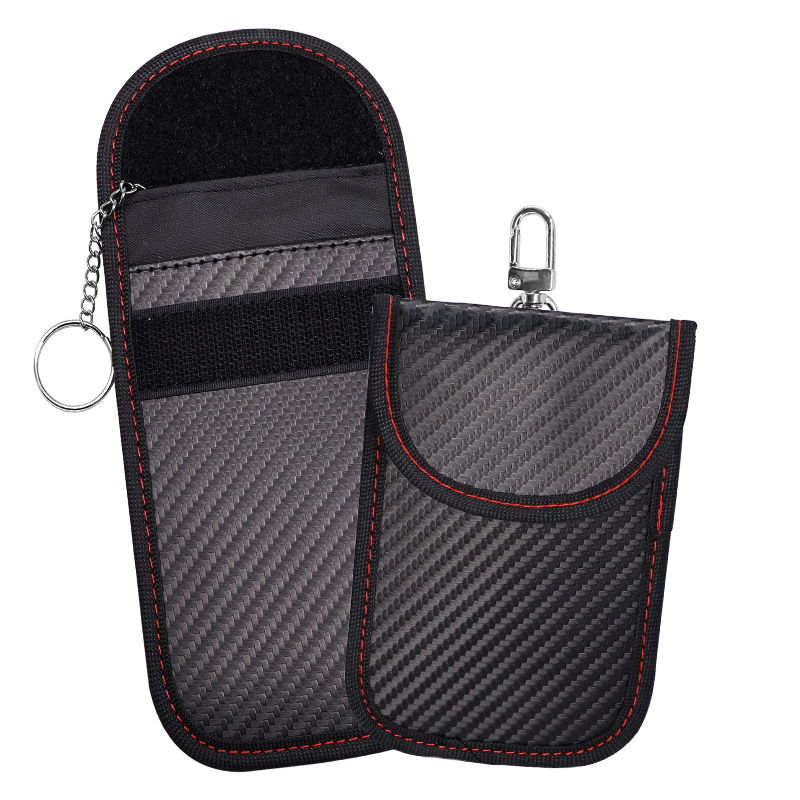
A faraday bag is a soft enclosure whose interior walls form a conductive cage. When a device inside transmits, the conductive layer carries induced currents that cancel the signal before it escapes; the same physics blocks incoming calls, GPS pings, and RFID reads. Working attenuation for a well-built bag runs 50 to 80 dB across the bands that matter — 315/433 MHz for key fobs, 700 MHz to 2.6 GHz for cellular, 2.4 and 5 GHz for Wi-Fi and Bluetooth, and 13.56 MHz for contactless cards.
Construction is a sandwich. The outer face is the visible material — carbon fiber weave for a technical look, 600D oxford fabric for durability, or PU leather for corporate branding. Behind it sit one or two conductive layers: a metallized fabric or foil laminate that does the actual blocking. A single thin layer can be defeated by folding damage and seam gaps, which is why serious bags use a double-layer liner with seams folded so the conductive path stays continuous around the closure. The innermost face is soft fabric so screens and leather fobs are not scratched.
Closures define the category. A hook-and-loop flap is the cheapest and most forgiving, but it wears out with use and can gape when the bag is full. A hanging ball closure — the drawstring-with-bead style popular on key pouches — pulls the mouth tightly shut and survives thousands of pulls. Magnetic flaps close one-handed but must be kept away from the shielded device pocket. Zip closures give the most confident seal for document-size bags, provided the tape is shielded or a conductive flap backs it.
Mistake 1: Skipping the no-service test before bulk. The fastest honest test costs nothing: put a phone inside, close the bag, and watch the signal indicator drop to no service within 30 seconds; call the phone and confirm it does not ring. A fob test is the same idea — place it in the bag, stand next to the car, press unlock. Buyers who order thousands of units on catalog claims without running this test on received samples routinely discover 10 dB gaps between batches.
Mistake 2: Buying single-layer bags for serious use. A single conductive layer works on the day it ships and degrades with every fold, and a single crease across a foil layer can open a leak path. Double-layer construction tolerates the folds and handling real users inflict, and it costs only a few cents more per bag at volume. Specify layer count in the purchase order, not just "faraday lining".
Mistake 3: Choosing a closure that gapes when full. A phone wallet stuffed with cards and a power bank stretches a hook-and-loop flap until the corner leaks. Test the bag loaded, not empty: fill it to intended capacity, close it, and run the phone test. If the format is meant to carry more than a fob, prefer drawstring ball closures or backed zips.
Mistake 4: Assuming waterproof means shielded. Many outdoor pouches are waterproof but use non-conductive liners — they keep rain out and let every signal through. Water resistance and signal blocking are independent features; a bag can and should have both, but the listing must state each separately and each needs its own test.
Vehicle and key fob protection buyers should choose the small pouch format with a hanging ball closure, sized for one or two fobs. This is the daily-use item: it hangs by the door, the fob goes in, the relay chain is broken. For households with two cars, a two-pack covers both key sets without sharing one pouch.
Privacy and corporate security buyers need the medium phone-size bag. Phones silenced this way cannot be reached, tracked, or read while in transit or in sensitive meetings — useful for legal teams, executives, and journalists. Specify cellular, Wi-Fi, and Bluetooth bands explicitly and require the no-service test on samples; some bags block fobs but not modern phone bands.
Insurance companies and car dealership programs order multi-pack kits with custom logos. A kit — two fob pouches plus one phone or document bag — is handed to every policyholder or new car buyer, turning a security feature into a brand touchpoint. For these programs, consistency matters more than anything: the factory must test per batch and hold logo plates for repeat orders.
Retail and e-commerce sellers should stock the family multi-pack as the hero SKU, with singles as entry items. Multi-packs carry better average order value and match how households actually use the product — several keys and at least one phone shielded at once. Packaging that invites the buyer to test immediately reduces returns and raises review quality.
| Spec | Key fob pouch | Phone bag | Document bag | Family multi-pack |
|---|---|---|---|---|
| Size | 130 x 90 mm | 200 x 110 mm | 300 x 220 mm | 2 small + 1 medium |
| Outer material | Carbon fiber / PU | Oxford fabric | Oxford fabric | Mixed |
| Shielding layers | 2 | 2 | 2 | 2 |
| Attenuation | 50–60 dB | 55–70 dB | 55–70 dB | 50–70 dB |
| Closure | Hanging ball | Hook-and-loop / zip | Zip with flap | Per component |
| Test standard | Live fob test | No-service test | No-service test | Both tests |
| Typical MOQ | From 500 | From 300 | From 300 | From 300 kits |
Custom logo programs are going mainstream. Insurance companies, car brands, and fleet operators now treat faraday kits as standard issue with policies and vehicles, so factories are asked for logo printing on oxford and PU faces plus branded insert cards that explain the test. Programs are won on per-batch testing discipline, not design.
Double-layer shielding is becoming the stated baseline. Reviewers and comparison videos now open bags and count layers, so listings that say "double-layer" — and mean it — convert better. Single-layer bags are retreating to the lowest price tier where they compete on price alone.
Materials are diversifying beyond black nylon. Carbon fiber weave for a technical look, PU leather matched to car interiors, and colored oxford fabrics for retail shelves all appeared this year, letting retailers position faraday bags as accessories rather than gadget protection. The shell does not affect shielding; the liner spec stays the constant.
Case 1: An insurance company's 8,000-kit policyholder program. The client's previous kit used single-layer pouches that failed phone tests when loaded, driving support calls. We rebuilt the kit with double-layer liners in both pouches, a hanging ball closure on the fob bags, and a zip-with-flap phone bag, then ran a loaded no-service test on 50 units per batch and attached the test log to each shipment. Artwork proofing took three rounds to place the logo without overlapping the seam fold. The 8,000 kits shipped in four weeks, the support line saw no shielding complaints, and the client renewed with a co-branded insert card for the next policy year.
Case 2: A US e-commerce seller fighting "does it block" reviews. Their carbon fiber pouches looked right but customers' fobs worked from inside the closed bag. We tore down a returned unit, found the conductive layer stopping short of the flap fold, and rebuilt the pattern so the liner path continued through the closure. Every batch was tested with a live 433 MHz fob at two distances and a phone no-service test, and the seller added a "test it in 30 seconds" card to the packaging. Within one quarter the product's average review rose from 3.8 to 4.6 and the seller doubled reorder volume to 6,000 units.
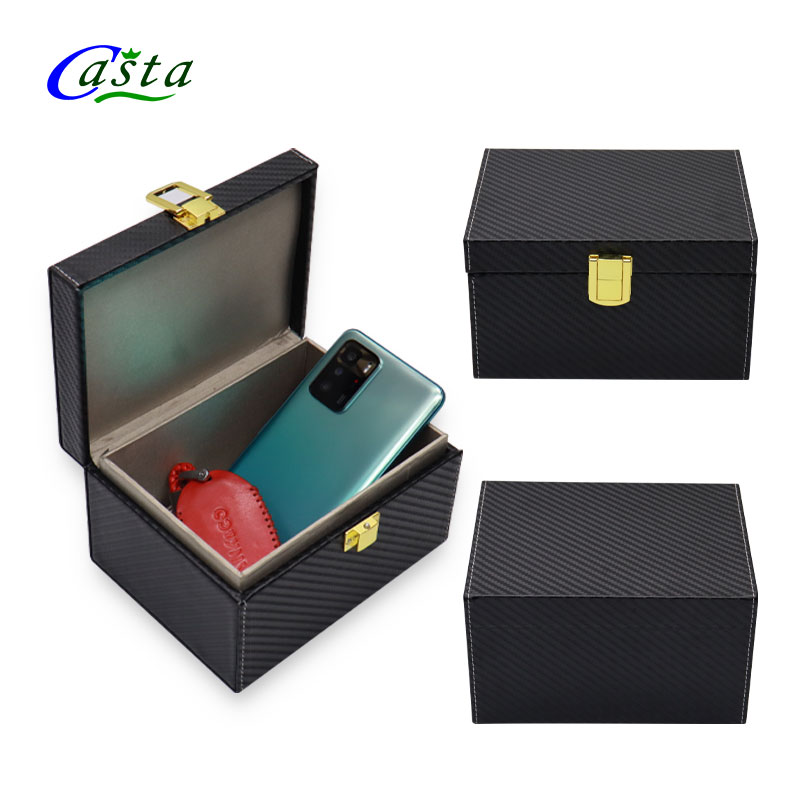
Shenzhen Casta Leather Co., Ltd manufactures faraday bags as tested security products first and branded accessories second, and for this category our relevant capabilities are: double-layer conductive liners verified per lot, closure engineering — hanging ball, backed zip, and reinforced hook-and-loop — chosen to keep the shielded path closed under real load, per-batch live fob and phone no-service testing with logged results, carbon fiber, oxford, and PU leather outer faces produced in-house, and custom logo programs for insurance, dealership, and retail partners from the low hundreds of units. We also build the matching faraday boxes and RFID wallets in the same security family, so multi-item kits ship with one quality standard. Format options and photos are at https://www.cncasta.com/.
Six steps carry a faraday bag from file to carton. First, spec confirmation: bag size, layer count, closure type, and target bands are fixed against the buyer's use case, and a digital proof of the logo placement is approved before cutting. Second, material preparation: conductive liner lots are checked for continuity, and outer faces — carbon fiber weave, oxford, or PU leather — are cut in matched panels. Third, shielding assembly: the double-layer liner is sewn with folded seams so the conductive path continues through every edge and around the closure zone. Fourth, closure fitting: the hanging ball, zip, or hook-and-loop is attached with the shielded flap positioned so a loaded bag still seals fully. Fifth, branding: logos are printed or embossed with a strike-off approved before the run, kept clear of the fold lines that carry flex. Sixth, validation: sampled bags are tested loaded — a live fob unlock test and a phone no-service test — the closure is cycled thousands of times, seams are inspected under raking light, and units are polybagged with instruction cards before carton packing.
Two quick tests cover it. For a phone: put the phone inside, close the bag, and confirm the signal drops to no service within about 30 seconds, then call the phone and verify it does not ring. For a key fob: place it inside the closed bag, stand next to the car, and press unlock — if the car responds, the bag is leaking.
A properly built double-layer bag attenuates cellular, Wi-Fi, Bluetooth, GPS, and 13.56 MHz contactless bands simultaneously, because the shielding is broadband. Bags built only for key fob bands may pass phone signals, so buyers should require the no-service phone test if phone shielding is part of the use case.
Standard formats start from about 300 to 500 pieces per design, and logo programs from the low hundreds. Pre-production proofs take five to seven working days and bulk typically ships in two to three weeks. Send artwork and quantities to yinjinfeng@szcasta.com or call +86 18675583959 (WhatsApp available) for a quote.
Only if specified and tested. Signal shielding and water resistance are independent: the outer fabric can be water-repellent and seams sealed without affecting the liner. We can combine both features, but buyers should confirm each claim separately, because many waterproof-looking pouches on the market are not shielded at all.
Shenzhen Casta Leather Co., Ltd
Hotline : +86 18675583959 (WhatsApp available)
E-mail : yinjinfeng@szcasta.com
Room 101, Unit 1, No.36 Ainan Road, Longdong Community, Baolong Subdistrict, Longgang District, Shenzhen City
Website: https://www.cncasta.com/


