

A faraday box is the simplest reliable defense against key fob relay theft, and it is also one of the easiest security products to buy badly: a box that blocks nothing still looks identical to one that blocks 60 dB, until a customer tests it and posts the result in a review. This guide explains how signal blocking actually works, how exterior materials — velvet, PU leather, carbon fiber — differ beyond appearance, what sizes suit multi-key households, where to place a box at home, and how Shenzhen Casta Leather Co., Ltd builds, tests, and custom-brands faraday boxes for retailers, car dealerships, and corporate gift programs.
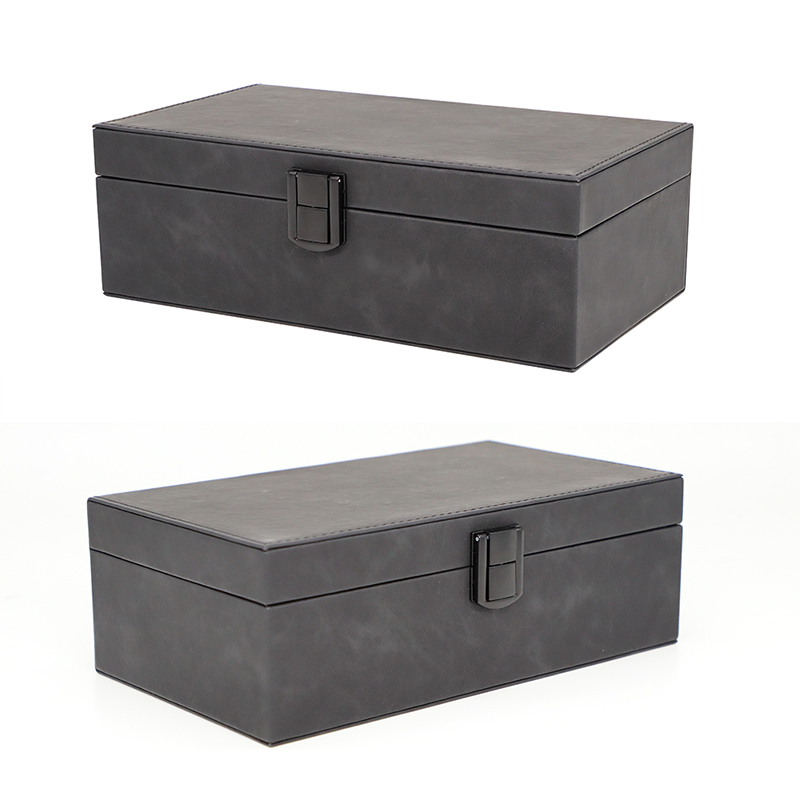
A faraday box applies the physics of a Faraday cage to a desktop object: a conductive enclosure surrounds whatever is inside, and incoming radio waves induce currents in the conductive layer that cancel the field before it reaches the contents. For car key fobs, the threat is the relay attack — two thieves, one near the house with a receiver and one at the car with a transmitter — extending the fob's range so the car unlocks and starts while the real key sits inside the home. A properly built faraday box cuts the fob's transmitted signal by 50 to 80 dB, which collapses the effective range to centimeters and defeats the relay chain.
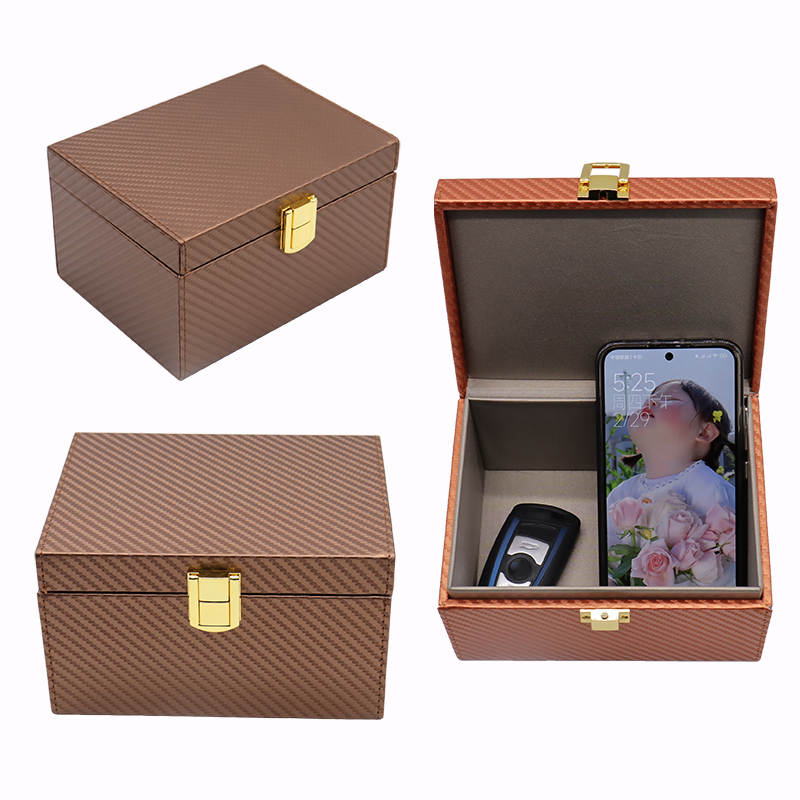
The box itself is constructed in layers. The outer shell carries the appearance — velvet-wrapped board, PU leather over rigid panels, or a carbon-fiber-textured finish — and provides the structure. Inside, the working layer is a conductive liner, usually a fabric or foil laminate woven with copper and nickel threads, covering the floor, walls, and lid. The critical engineering detail is continuity: shielding only works if the conductive layer forms an unbroken path around the contents, so the lid seam must overlap or make contact when closed, and any stitching holes must not create gaps along the edges. This is why two boxes with identical exteriors can differ by 30 dB in real performance.
Boxes are sized by key count. A single-key box holds one or two fobs; a family box has interior compartments for four to six keys plus cards; and display boxes for showrooms hold ten or more fobs on a felt-lined tray. Interior surfaces are typically finished in soft velvet or microfiber so fobs and key rings are not scratched every time they are dropped in.
Mistake 1: Buying on exterior looks instead of lining quality. A handsome carbon fiber shell sells the product, but the shell contributes nothing to blocking — the conductive liner does. Some low-cost boxes use a single thin foil layer that creases and cracks at the fold lines within months. Ask the supplier to specify the liner material, the number of layers, and the measured attenuation in dB, in that order, before comparing prices.
Mistake 2: Skipping the live-fob test. Marketing claims are not measurements. The honest test takes one minute: put a real fob inside, close the lid, stand next to the car, and press unlock. If the car responds, the box fails. Retailers should run this test on samples from every production batch, because liner lots change and a new lot can quietly cost 15 dB.
Mistake 3: Under-sizing for the household. A box that holds one key gets abandoned the moment a second car enters the family, because people will not stack fobs in a tight box any more than they will hunt for change. Choose interior volume for the household's full key set plus a small allowance for cards or a spare battery.
Mistake 4: Ignoring the lid seam. The seam where the lid meets the body is the weak point of every faraday box. A lid that simply sits on top of an open-topped liner leaks signal at the gap. Look for a folded conductive flap that overlaps into the box interior, or a liner that is continuous from body to lid, and ask the factory how the seam contact is maintained after thousands of open-close cycles.
Retail and e-commerce sellers should stock a two-SKU lineup: a compact single-key box with a premium velvet finish for gifting, and a family-size box for the practical buyer. Both should ship with a simple test card that invites the customer to try their own fob — pre-empting the "does it work" review question and turning testing into a trust moment.
Car dealerships and insurance programs typically order countertop boxes with their logo, handed out with every new car or policy. Here the priority is brand presentation and consistent shielding across thousands of units, which means the factory must hold liner lot control and test per batch. PU leather finishes emboss and print logos cleanly and survive showroom handling.
Corporate gift and security-conscious buyers often want a box that also serves as an entryway organizer — a place for keys, cards, and small valuables. Multi-compartment boxes with a velveteen interior and a weighted base fill this role, and they photograph well in corporate gift catalogs alongside wallets and card holders.
Wholesale distributors supplying security retailers need documented attenuation numbers and repeat-order consistency. The deciding factors are the supplier's test protocol, retained golden samples, and the willingness to run a third-party or in-house shielding report per lot rather than per year.
| Spec | Compact single-key | Family multi-key | Dealership display | Gift premium |
|---|---|---|---|---|
| Exterior size | 120 x 90 x 60 mm | 180 x 130 x 80 mm | 250 x 180 x 70 mm | 130 x 100 x 65 mm |
| Key capacity | 1–2 fobs | 4–6 fobs + cards | 10+ fobs on tray | 2 fobs |
| Shell material | PU leather | PU leather | Carbon fiber finish | Velvet over board |
| Liner layers | 2-layer conductive | 2-layer conductive | 2-layer conductive | 2-layer conductive |
| Attenuation | 50–60 dB | 50–60 dB | 55–65 dB | 50–60 dB |
| Lid seam | Overlap flap | Overlap flap | Continuous liner | Overlap flap |
| Typical MOQ | From 300 | From 300 | From 500 | From 300 |
Buyers now ask for dB numbers, not adjectives. Reviews and social media have taught consumers to test their boxes with real fobs, so listings that quote measured attenuation and invite testing convert better than vague "signal blocking" claims. Factories that can supply per-batch test reports are becoming the default source for serious retailers.
Premium finishes are moving up the price ladder. Velvet-wrapped boxes and carbon fiber textured shells let the category escape the five-dollar commodity shelf, and gift retailers now position faraday boxes next to leather wallets as security-meets-style products. The shell upgrade costs little; the quality gap remains in the liner and seam.
Multi-function interiors. Newer designs combine the shielded fob compartment with open storage for cards, watches, and earbuds — acknowledging that households treat the box as an entryway organizer first and a security device second. The engineering constraint is keeping the shielded compartment sealed while the open sections stay accessible.
Case 1: A UK security retailer with a 5,000-unit relaunch. Their previous supplier's boxes passed the initial sample but failed in customer reviews — fobs worked from inside the box with the lid shut. We tore down the old sample, found a single foil liner cracked at every fold, and rebuilt the box with a two-layer conductive fabric liner and an overlapping lid flap that maintains contact under the lid weight. Forty units per batch were tested with live 433 MHz and Bluetooth fobs in a controlled setup, with attenuation logged per batch. The relaunch shipped in 25 days; review scores moved from 3.6 to 4.7 stars and the retailer committed to quarterly repeat orders.
Case 2: A German automotive dealership gifting 2,000 branded boxes. The client wanted the dealership logo on a carbon fiber finish box handed over with every new car, plus interior space for two fobs and a parking card. We produced a pre-production proof with a foil-stamped logo, adjusted the felt tray so key rings did not scratch the interior, and ran a 5,000 open-close cycle test to confirm the lid seam held contact. The order shipped in three weeks with per-batch fob tests attached to the packing list, and the client added a matching faraday bag for the service department.
Shenzhen Casta Leather Co., Ltd builds faraday boxes as tested security products dressed in leather goods craft, and for this category specifically our relevant capabilities are: multi-layer conductive liners sourced and verified per lot, lid seam construction with overlapping contact flaps that survive thousands of cycles, in-house live-fob testing on every batch with logged attenuation, velvet and PU leather and carbon fiber shell finishing under one roof, and logo programs — foil stamp, emboss, or print — starting from the low hundreds of units. We hold golden samples per SKU so repeat orders are compared physically, not just by spec sheet, and we box faraday products together with the bags and keychains in the same security family for bundled retail. Product photos and format options are at https://www.cncasta.com/.
Six steps carry a faraday box from order to carton. First, liner verification: conductive fabric is checked per lot and a reference attenuation is measured before any shell is wrapped. Second, shell fabrication: rigid board is cut and wrapped in velvet, PU leather, or carbon fiber finish, with edges folded so the shell never exposes board at the seams. Third, lining assembly: the conductive liner is fitted to floor, walls, and lid as a continuous path, with the overlap flap positioned so closing the lid completes the enclosure. Fourth, interior finishing: velvet or felt surfaces are fitted so fobs and rings land softly, and compartments or trays are added per the household or display configuration. Fifth, branding: foil stamping, embossing, or printing is applied with a test strike approved before the run. Sixth, validation: sampled boxes are closed on live fobs and tested for unlock response at set distances, the lid seam is cycled thousands of times and re-tested, and interior surfaces are inspected for scratches before individual polybag packing.
Place a working fob inside, close the lid, stand beside the car, and press unlock — if the car responds, the box is leaking. We run exactly this live-fob test per batch, plus a controlled attenuation measurement, and we encourage retailers to repeat the test on received samples before listing.
Velvet reads as premium gift, PU leather embosses and prints logos cleanly for corporate branding, and carbon fiber finish suits automotive styling. The shell is cosmetic; shielding comes from the interior liner, so choose exterior by market and interior by specification.
A box with interior capacity for four to six fobs plus a few cards covers a two-car household with spares. Undersized boxes get abandoned because users will not stack fobs, so err toward the family size even for small households.
Standard formats start from about 300 pieces per design, with logo customization from the low hundreds. Pre-production proofs take five to seven working days and bulk typically ships in two to three weeks. Send artwork and quantities to yinjinfeng@szcasta.com or call +86 18675583959 (WhatsApp available) for a quote.
Shenzhen Casta Leather Co., Ltd
Hotline : +86 18675583959 (WhatsApp available)
E-mail : yinjinfeng@szcasta.com
Room 101, Unit 1, No.36 Ainan Road, Longdong Community, Baolong Subdistrict, Longgang District, Shenzhen City
Website: https://www.cncasta.com/


